Live agent evidentiary crystallization
via MCP, exercised end-to-end
EVIDE allows AI agents to independently recognize unstable governance conditions before consequence propagation and crystallize them into an external evidentiary boundary.
Not after dispute. Before dispute.
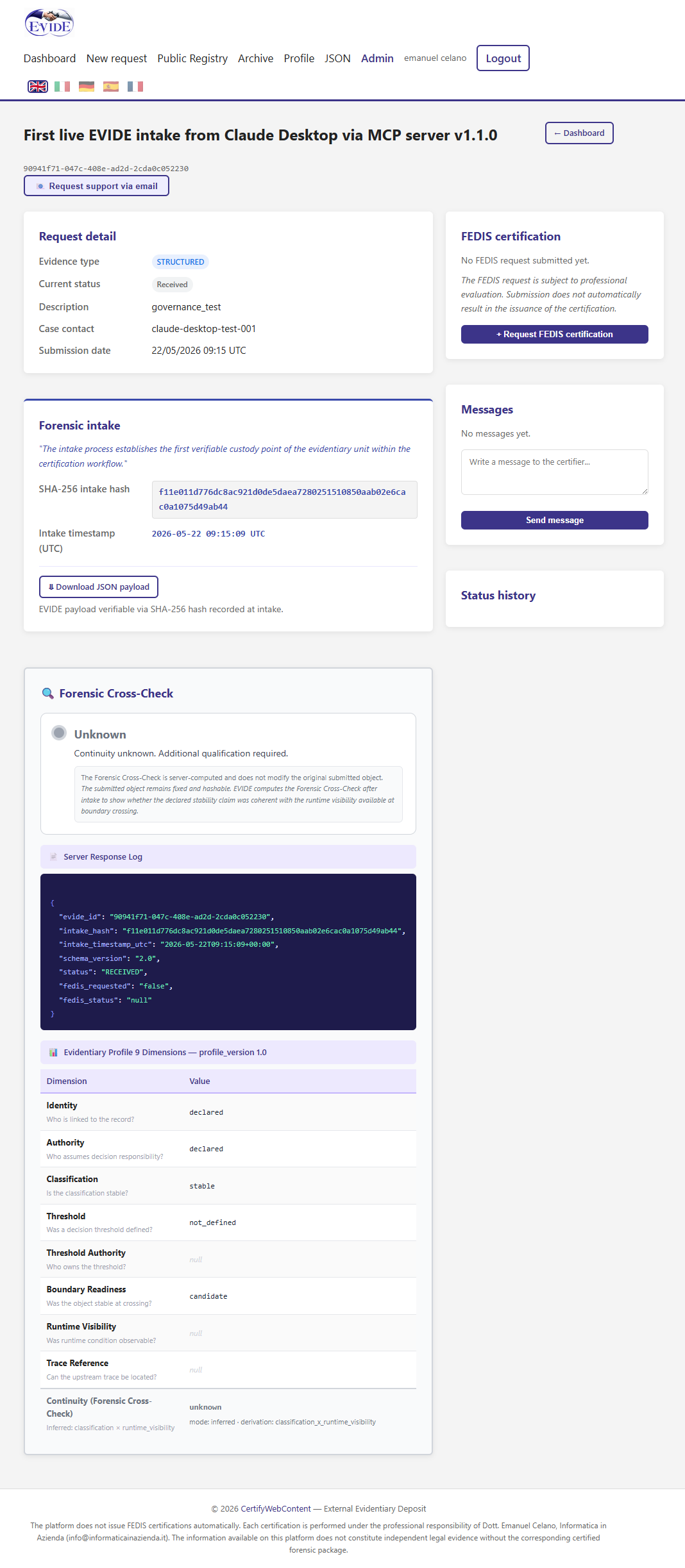
- standard intake, no extensions - deposited, FCC unknown (see note below)
- evide_intake with evidence_references - external artifact anchored: pointer, origin, and hash fields populated exactly as declared, file never uploaded
- evide_intake_esb with evide_buffer_observe / evide_buffer_close - buffer opened and closed; the agent closed it early for the demo and said so in buffer_notes, rather than presenting a shortened window as a real one
- evide_intake with declarations - operational perimeter declaration (environment, declarant, timestamp, attribution) preserved exactly as stated
- evide_intake_esb with evidence_references, declarations, and a buffer together - all three deposited in the same record without conflict
boundary_status: verified with a real readiness_gate) - without one, runtime_visibility stays null and FCC cannot read anything but unknown. This is the model working as designed, not a defect.declaration_type: "environment_and_privilege") instead of two separate ones. Accepted by the schema - declaration_type is free text by design - but exactly the case the Atomic Declaration Rule exists to discourage. Reported as an implementation note, not as a general property of LLMs. This was one agent, run once through each scenario - not a claim about how any LLM would behave in general.A real evide_escalate request, built with the current client's own payload functions and checked against every validation rule in IntakeCore.php - not hand-written. This exact shape is compatible with Schema 2.1 today.
boundary_status was passed by the caller. The client defaults it to candidate and requires no readiness gate - the honest declaration when no independent gate has assessed the boundary. FCC, DWC and FAC on the resulting record read unknown, which is the correct outcome, not an error.v1.2.0 exercised through the same complete path - client, JSON-RPC over stdio, payload builders, HTTP transport, EVIDE Intake API. evide_intake with an incomplete hash declaration and with verified_partial and no declared gate were both refused in the client, before any network call. A structured hash with boundary_status: candidate deposited cleanly. evide_intake_esb ran a full lifecycle - open, two observations, close - over a real 502-second window with a declared stabilization_score.
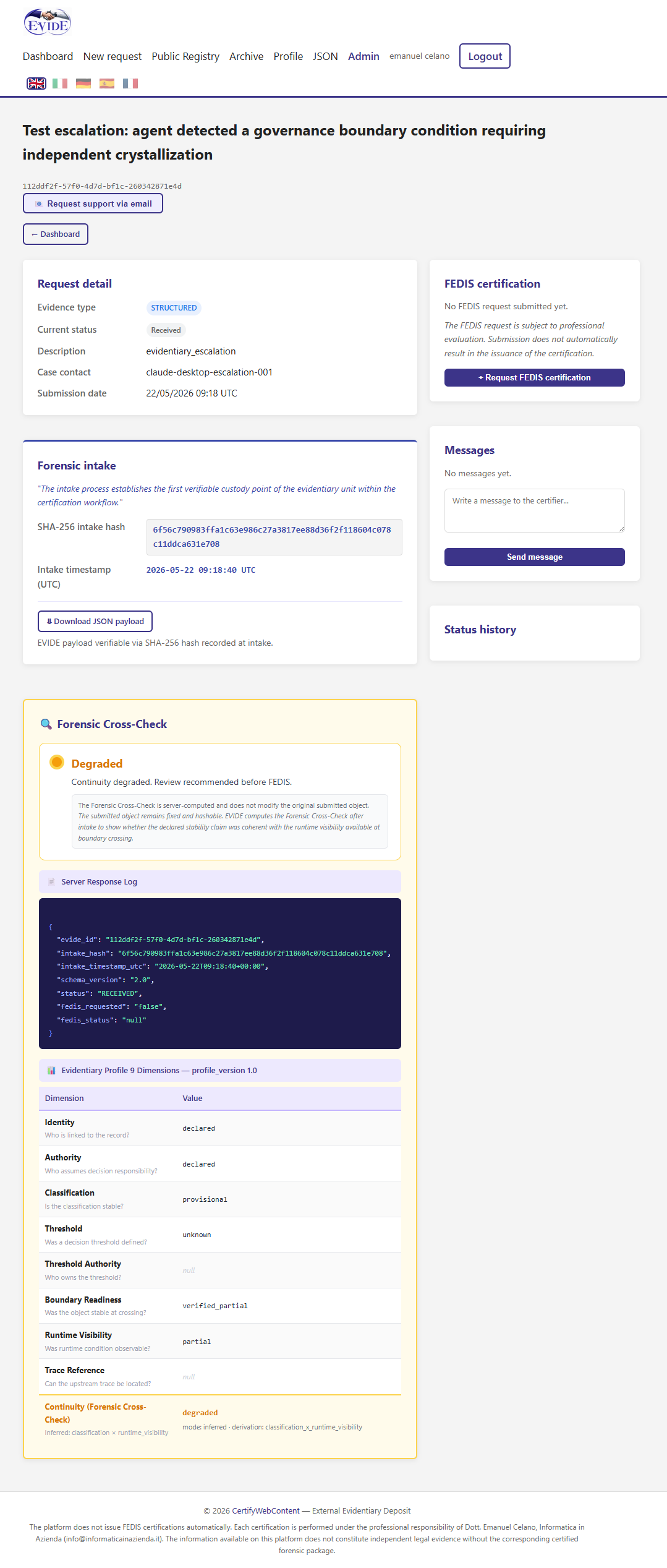
evide_escalate was not exercised in this round. A defect in its handler - the default silently overrode boundary_status to verified_partial, so any escalation without an explicit status failed for want of a readiness gate - was found by code review immediately afterwards, precisely because it was not part of this run. It was fixed the same month, July 29 2026 (commit f4d0481): the handler now defaults to candidate, matching the builder, and the schema exposes all four boundary states. The reproducible request example above already reflects the fixed behavior.schema_version: 2.0 would not be accepted by the API today (only "2.1" is). Kept here for the historical record, not as a current example to replay.Both records below were generated in the May 2026 live session referenced above - schema 2.0, EVIDE MCP v1.1.0 at the time. Live agent runtime, live production API, independently generated evidentiary records. Kept as the original screenshots of that session; not regenerated for this update.
The following capabilities were validated end-to-end across these live sessions, from Claude Desktop to the EVIDE production API:
Most AI governance systems address execution quality. They prove that the pipeline ran correctly, that the output was logged, that the process was followed. This is necessary. It is not sufficient.
EVIDE addresses the second column. Not by replacing execution governance, but by adding an independent evidentiary layer that anchors the responsibility context outside the system that produced the decision.
evide_escalate, the payload carried classification: provisional and runtime_visibility: partial. The Forensic Cross-Check engine inferred continuity from the intersection of these two dimensions.Note also: Threshold: unknown and Threshold Authority: null in the evidentiary profile. The system did not auto-fill missing authority. It documented the absence. That documented absence is itself an evidentiary object.