Section 1
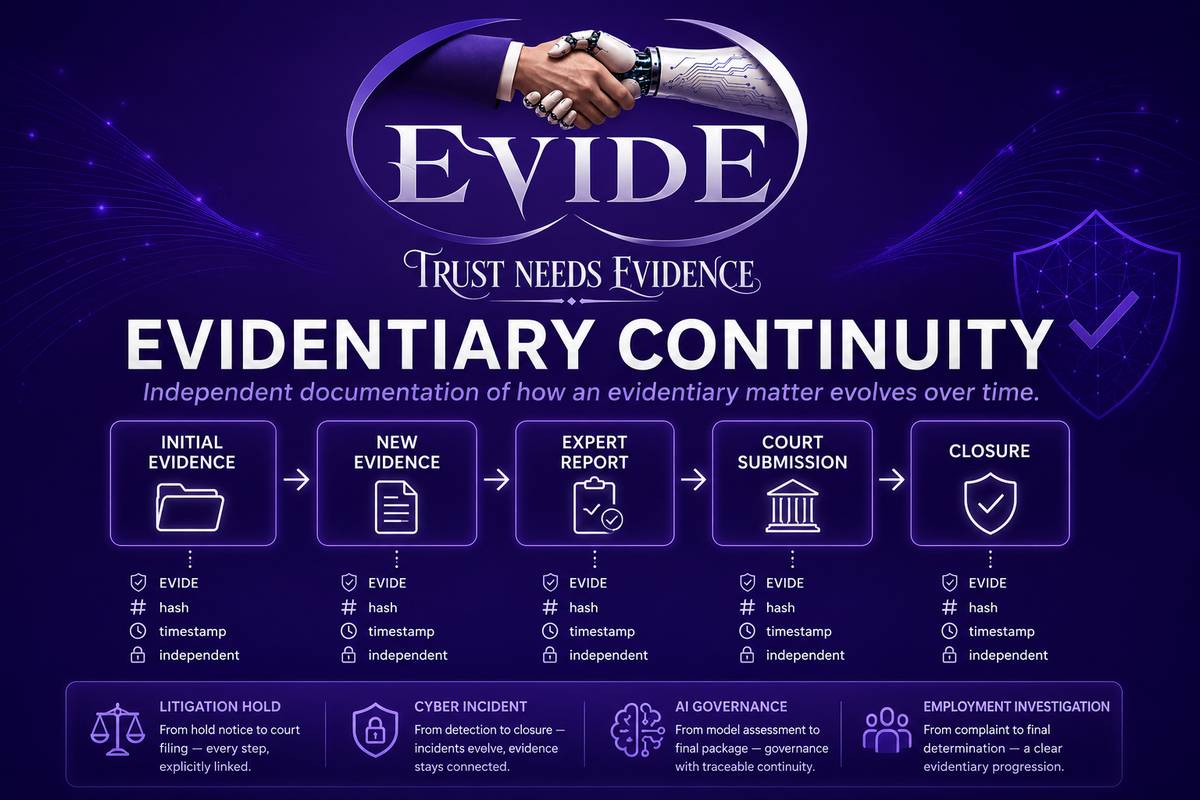
1. How Evidentiary Matters Evolve
The same underlying matter, observed at five different moments.
Initial evidence
↓
New evidence
↓
Expert report
↓
Court submission
↓
Closure
Each step - EVIDE → hash → timestamp → independently verifiable
Section 2
2. The Problem
A legal matter does not remain static. A cyber incident does not remain static. A robotics investigation does not remain static. An AI governance dispute does not remain static.
Yet traditional evidence preservation usually certifies individual artifacts, not the relationship between them.
Without an explicit continuity model, it becomes difficult to demonstrate:
- why a second record exists
- how it relates to the first
- whether the chain remained intact
- whether unrelated matters were accidentally mixed
Section 3
3. What EVIDE Does
Record A
↓
Record B
↓
Record C
Each record is certified. Independent. Immutable.
But linked.
The relationship is declared. The records remain independent.
Section 4
4. Design Principles
Immutable continuity
A relationship can be created. It cannot later be rewritten.
Explicit parent
Every continuation explicitly identifies the previous record. Silent continuation is impossible.
Strict validation
If the parent does not exist, the request fails. It never silently starts a new chain.
Evidentiary boundary preservation
Personal and organizational evidentiary domains never collapse into each other. A change of acting capacity creates a new evidentiary boundary.
Matter compatibility
Two unrelated matters cannot accidentally become one chain.
Independent records
Every record remains independently verifiable. Destroying one record does not invalidate the others.
Section 5
5. Typical Examples
Litigation Hold
Step 1 → Additional evidence → Expert report → Court filing
Cyber Incident
Detection → Forensic acquisition → Expert analysis → Authority notification → Closure
AI Governance Dispute
Initial model assessment → Runtime incident → Additional artifacts → Expert opinion → Final evidentiary package
Employment Investigation
Complaint → Witness statements → Digital evidence → Final determination
Section 6
6. How to Submit an Intake
Two channels, the same evidentiary record
EVIDE supports two intake channels.
Law Firm / Organization
↓
Manual Upload
EVIDE Portal
↓
Upload files
or
API Integration
Case Management Software
↓
API
↓
EVIDE
Manual Upload
The user logs into the EVIDE portal and manually uploads the files to be certified.
- lawyers
- technical consultants
- professional firms
- investigators
- companies with occasional submissions
No software integration is required.
API Integration
Organizations with case management software can submit intakes directly to EVIDE through the API.
The software builds the payload and transmits it to EVIDE automatically.
The user keeps working inside their own software without ever needing to access the portal.
- case management software
- legal practice management systems
- GRC platforms
- incident response systems
- digital forensics platforms
- third-party applications
Both channels produce the same EVIDE evidentiary record. Only how the intake is submitted changes.
Section 7
7. API
A continuation is declared through a chain object in the intake payload - part of the base schema, no extension declaration required.
Declaring a continuation
{
"chain": {
"chain_type": "litigation_hold",
"parent_evide_id": "b39d0270-c894-4598-9dd4-c272341b544e",
"matter_reference": "CLIENT-2026-0417"
}
}
chain_type - free text describing the nature of the continuation (e.g. litigation_hold, internal_investigation, incident_response, due_diligence). No fixed enum.parent_evide_id - the EVIDE ID of the record this one continues. Must exist, must belong to the same evidentiary domain, must be in an accepted status.matter_reference - optional. If declared on both sides, it must match. If omitted, it is inherited automatically from the parent, so the safeguard stays active across the whole chain without repeating it at every step.
The chain relationship is resolved server-side after successful validation. The client declares; EVIDE decides.
Response - the resolved chain state
{
"chain": {
"chain_position": 2,
"chain_type": "litigation_hold",
"chain_root_evide_id": "b39d0270-c894-4598-9dd4-c272341b544e"
}
}
Full schema reference: app.certifywebcontent.com/docs/evide-intake-schema/
Building case management, legal practice management, GRC, or incident-response software? Evidentiary Continuity is designed to be embedded directly into third-party platforms through the API described above - your users gain certified, chained evidentiary records without leaving your product. To discuss integration, contact
info@certifywebcontent.com.
Section 8
8. Guarantees
| Question | EVIDE |
|---|
| Parent exists | ✓ |
| Parent status valid | ✓ |
| Same evidentiary domain | ✓ |
| Same matter | ✓ |
| Immutable relationship | ✓ |
| Independent verification | ✓ |
| Silent fallback | Never |
Section 9
9. What Evidentiary Continuity Does Not Do
- It does not prove that two events are related.
- It does not replace chain of custody.
- It does not merge separate matters.
- It does not modify previously certified records.
Section 10
10. Who It Serves
General Counsel & Legal Teams
Manage evolving evidentiary matters with explicit continuity.
Compliance & External Auditors
Document successive assessments without losing evidentiary context.
Incident Response & Investigation Teams
Preserve the relationship between evolving records across an investigation.
Section 11
11. Try It Yourself
Hands-on Evaluation
Want to see a continued record for yourself? Try EVIDE free in the Lab.
The EVIDE Governance Lab lets you submit real evidentiary intakes and download the automatically generated Evidentiary Artifact Record (EAR). No DAPI identity verification. No integration. No commitment. No cost.
Open EVIDE Governance Lab ↗
Lab environment - for exploration and testing only, no legal or evidentiary value.
EVIDE does not prove that two events belong together. It independently documents that the author explicitly declared their continuity, under a verified evidentiary chain, at a specific point in time. That distinction preserves evidentiary neutrality.
EVIDE does not create continuity.
It documents declared continuity under independently verifiable evidentiary relationships.