
EVIDE vs Execution Certification
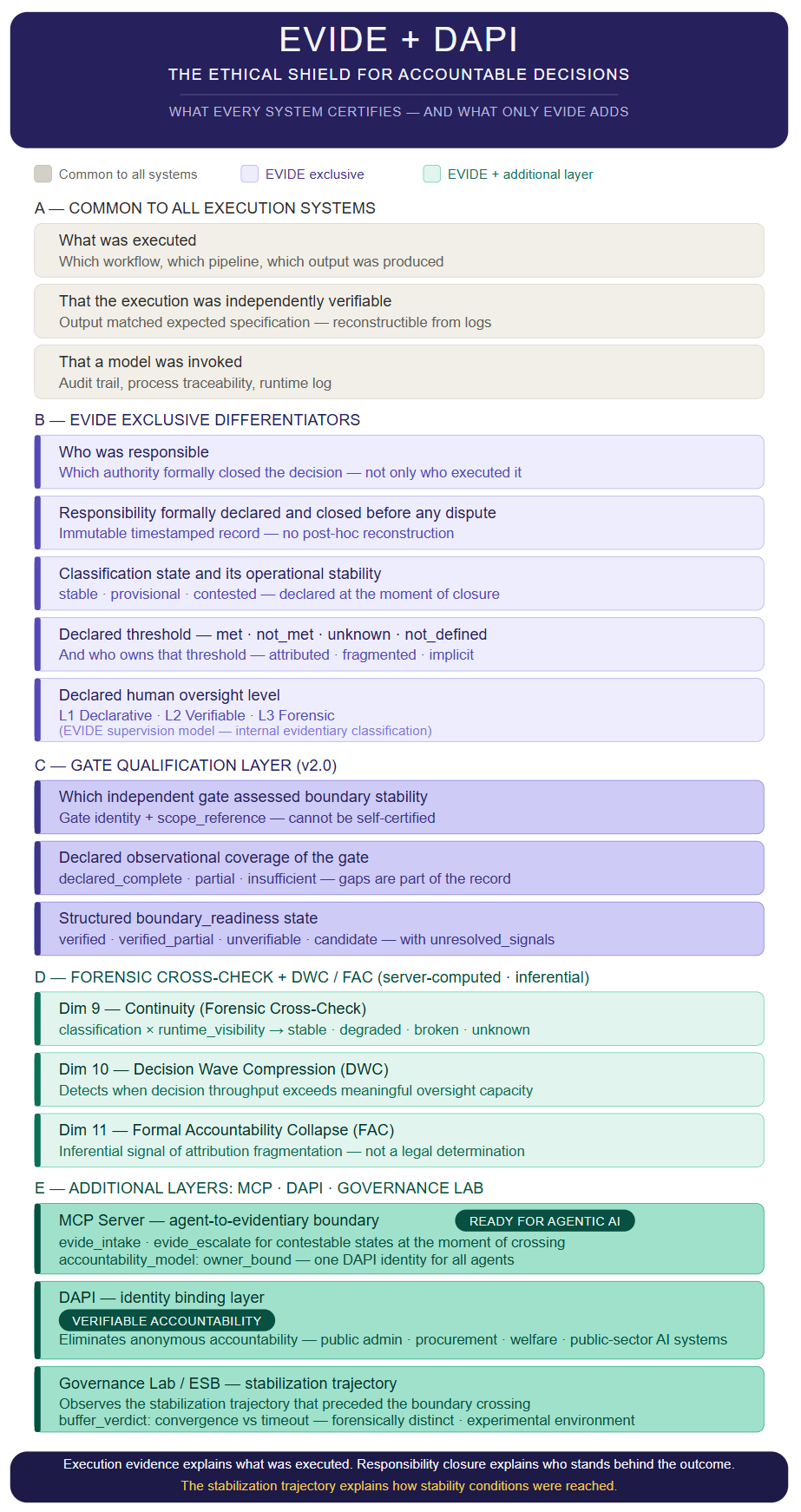
Visual summary · v2.1 — full analysis below · click to enlarge
- 1. The core distinction
- 2. What most systems prove
- 3. What EVIDE proves
- 3b. Execution integrity vs responsibility continuity
- 3c. MCP Server: the agent-to-evidentiary boundary
- 3d. EVIDE Governance Lab & the Epistemic Stabilization Buffer
- 3e. Evidentiary Continuity: chaining responsibility across decisions
- 4. EVIDE is not an observability layer
- 5. Before dispute vs after dispute
- 5b. DAPI: the Identity Binding Layer
- 6. Why this matters for the AI Act
A growing class of systems focuses on proving that an AI pipeline ran correctly: deterministic execution logs, reproducible outputs, runtime audit trails, behavioral proofs. These are valuable and necessary. They answer the question:
EVIDE answers a different question:
"Who was responsible for the decision that resulted from that execution — and was that responsibility formally closed, bound, and independently verifiable before any dispute arose?"
These are not competing answers. They address different evidentiary layers. Confusing them leads to governance gaps that become visible only under audit, litigation, or regulatory investigation.
Execution certification systems are designed to make the machine behavior provable. They focus on:
| Execution Systems Prove | EVIDE Proves |
|---|---|
| What executed | Who was responsible |
| Which workflow ran | Which authority closed the decision |
| Which output was produced | Under which admissibility conditions it was accepted |
| Which pipeline generated the result | Which human responsibility state existed at closure |
| That a model was invoked | That a named authority was verifiably bound to the outcome |
| That the execution was deterministic | That the classification context was explicit and anchored |
| That the output matched a specification | That the threshold state was declared and recorded |
| Gate visibility: usually not part of the evidentiary object | Which independent gate assessed boundary stability |
| Boundary qualification: usually not represented | Boundary qualification state — verified · verified_partial · unverifiable · candidate |
| Evidentiary dimensioning: not represented | Eleven-dimensional evidentiary profile (server-computed) including continuity inference via Forensic Cross-Check (Dim 9), Decision Wave Compression / DWC (Dim 10), and Formal Accountability Collapse / FAC (Dim 11) — anti-Synthetic-Coherence sensors |
They cannot say: "this responsible human authority was verifiably bound to this closure state — and the gate's visibility limits were recorded as part of the evidentiary object — before dispute."
EVIDE operates at the responsibility closure boundary — the moment a decision formally becomes the declared responsibility of an identified, authority-bound human actor. EVIDE anchors:
- the identity of the authority who declared responsibility
- the intervention type and rationale at the moment of closure
- the classification state and its operational stability
- the upstream governance structure that was active
- the threshold that was declared met, not met, or not defined
- the admissibility conditions that existed at the closure point
- the human oversight level that was declared
- the authority attribution status of the threshold owner
- which independent gate assessed boundary stability at closure
- the gate's observational coverage — declared, partial, or insufficient
- which signals remained unresolved at the moment of boundary crossing
EVIDE proves the responsibility structure that existed when the decision was formally closed."
evidentiary_profile — a server-computed eleven-dimensional read of the intake object.
This is the evidentiary object that matters when a decision is challenged externally — in audit, in court, in regulatory review. Not the execution log. The responsibility record.
A system can continue executing — producing outputs, maintaining workflow stability, appearing structurally sound — while the responsibility coherence beneath that execution has already degraded at the moment the closure state was externalized.
This is the architectural gap that execution certification cannot surface. Execution validity and continuity stability are measured against different reference axes.
↓
runtime visibility degrades
↓
continuity becomes degraded // Forensic Cross-Check detects this
↓
DWC / FAC may emerge // oversight throughput exceeded / accountability fragmented
↓
closure still externally anchorable // EVIDE records the degraded state, not a clean one
This condition is not invisible to EVIDE. The evidentiary profile exposes it through three inferred dimensions:
- Dim 9 — Continuity (Forensic Cross-Check): detects tension between declared classification stability and observable runtime surface at crossing-time. An execution-valid, continuity-degraded closure produces
state: degraded— notstable. This is a deterministic server-side computation from declared payload fields:classification_status × runtime_visibility → continuity_state. - Dim 10 — Decision Wave Compression (DWC): detects when the throughput of meaningful oversight has been exceeded — when decisions accumulate faster than the authority structure can absorb them with genuine oversight. The principle: meaningful oversight has a throughput boundary.
- Dim 11 — Formal Accountability Collapse (FAC): detects when the formal attribution of responsibility has fragmented — when authority is declared but not structurally coherent at the moment of closure. FAC is not misconduct. It is the condition in which compliance remains formally visible while signals consistent with degraded oversight conditions are structurally present.
degraded continuity state with detected DWC does not invalidate the closure — it makes the degradation itself part of the independently verifiable record.
As AI agent populations grow, the question of who is responsible for what an agent decides cannot be answered by execution logs alone. The agent produces the decision. But who is accountable for it — and can that accountability be proven independently, before any dispute arises?
The EVIDE MCP Server v1.1.0 is the answer to this question at machine scale. It is not a logging tool. It is an agent-to-evidentiary accountability boundary.
A Claude Desktop agent independently detected a governance uncertainty condition and triggered evide_escalate via MCP — producing a real-time evidentiary crystallization with hash, timestamp, FCC result, and owner attribution. To our knowledge, this is the first publicly documented EVIDE-native case of an AI agent autonomously creating an independently verifiable responsibility record at the exact moment of boundary crossing.
accountability_model: owner_boundThe architectural principle: accountability_model: owner_bound records that, within the EVIDE evidentiary model, accountability for the deposit remains associated with the DAPI-verified owner rather than being transferred to the referenced agent. This does not constitute a legal determination of responsibility. One human or organization can own many agents. All deposits converge on a single attributable accountability identity. This is what makes DWC computable at population scale.
Two tools. Two functions. Both independently verifiable, both owner-attributed:
evide_intake
— deposits a finalized AI decision as an independently verifiable evidentiary record.
evide_escalate
— crystallizes a high-stakes, contestable, or governance-uncertain state before the agent proceeds — creating a tamper-evident record preserving that the agentic workflow declared the condition at that material point, rather than silently proceeding.
Most AI governance systems record the final output of a decision: a response, a log, a snapshot. But they do not observe what happens while the decision is forming and crossing the layers of the system.
The problem is that two decisions with the same final output can have completely different trajectories — one genuinely stable, the other apparently stable but with degraded continuity beneath the surface. Traditional systems cannot distinguish the two.
The ESB is not a monitoring tool and not a demo environment. It is an observation lifecycle inserted between intake and crystallization. It does not delay the decision. It observes the stabilization trajectory that produces it. The ESB is currently part of an experimental research environment within the EVIDE Governance Lab. It does not determine truth, cognition, or semantic correctness. It observes boundary-relevant stabilization conditions during experimental governance trajectory analysis.
During the buffer window, the system tracks and forensically logs four dimensions across multiple timestamped observations:
buffer_verdict = stable means "sufficiently stabilized for crossing" — NOT absolute epistemic truth. A buffer closed by timeout is forensically distinct from a buffer closed by convergence. The result is an immutable forensic event log that shows not only what was decided, but how it was stabilized — including all intermediate observations.
The EVIDE Governance Lab is where architectural hypotheses from Recursive Semantic Governance (RSG) are stress-tested under controlled experimental conditions before canonical deployment. External researchers — developers, AI governance specialists, legal tech professionals — can apply for free research access.
A single closure record answers who was responsible for one decision. But consequential decisions are rarely single events. They are sequences: an initial assessment, a revision after new information, an escalation, a final determination — each one closed by an authority, sometimes by different authorities, sometimes months apart.
Execution systems can link these events. A correlation ID, a trace, a parent-child relation in a log store. But a linked log remains an internal reconstruction: it proves that records reference each other inside the system that produced them. It does not prove that responsibility for each step was independently bound at the moment that step was closed — nor that the sequence itself cannot be rewritten afterwards.
EVIDE chains responsibilities.
A deposit declares its position in a lineage by binding itself to a previously deposited evidentiary object. Chain position, chain root, and declared chain type are computed server-side and returned in the intake response — established at deposit time, never inferred later by whoever is reading the records.
The matter_reference exists to prevent a structural failure that is invisible in log-based systems: unrelated matters converging into a single lineage inside the same organization, producing a chain that looks coherent and is evidentiarily meaningless.
A second constraint operates on ownership. A chain cannot cross ownership domain types: a lineage opened under an organizational credential cannot be silently continued under a personal one, and the reverse is equally rejected — even when the same human being is behind both. Personal and organizational accountability domains never collapse into each other.
Every layer covered so far anchors something after a decision closed, or while it was being observed. None of them answer a different, earlier question: what was the agent authorized to do, in which environment, with which privileges — before it ever acted?
Execution systems can enforce a permission at runtime. A role, a scope, an access-control list. But enforcement is not evidence: if the permission was misconfigured, or the boundary was only ever an unwritten assumption, an execution log shows what happened — never what anyone had independently declared should be allowed to happen.
EVIDE anchors what was declared about it.
A deposit can carry one or more declarations — explicit, attributable, time-bound statements of the operational perimeter an agent was authorized within, before it acted: environment, privileges, purpose, tools, prohibited operations, agent configuration. Each is preserved with a server-computed digest, established at deposit time, never inferred later by whoever is reading the record.
Motivating incident: an AI agent connected to a production database mistook it for a disposable test environment and destroyed 22 tables while executing a routine migration. The failure was not only the agent's — the boundary between production and development had never been declared in a form that could be independently reconstructed afterward, only assumed.
EVIDE is frequently misread as a governance dashboard, an audit log, or an AI monitoring tool. It is none of these.
EVIDE exists at the responsibility closure boundary. It creates independently verifiable evidentiary objects that bind:
/.well-known/governance-layer-manifest.json — following the Governance Layer Manifest (GLM) open standard. The manifest declares layer_type: "closure", timing_axis: "post-bind", and execution_capability: false in a hashable, independently verifiable format. Any adjacent governance system can machine-read EVIDE's scope, non-claims, and composability constraints without requiring bilateral documentation review.The most critical architectural distinction between execution certification and EVIDE is temporal — and it defines liability exposure.
When a decision is challenged, the system must reconstruct who was responsible: searching logs, cross-referencing audit trails, inferring authority chains. This reconstruction is always contestable — it depends on the integrity of the very system that is under scrutiny.
EVIDE anchors the responsibility structure at the exact moment of closure, under a verified identity. When the decision is challenged — days, months, or years later — the record already exists. No reconstruction is needed. No inference is required.
EVIDE + DAPI bind responsibility before dispute."
This is not a technical feature. It is an evidentiary position. And in the context of the AI Act, it is the difference between being able to demonstrate compliance and being forced to reconstruct it.
EVIDE can anchor a closure state. But anchoring a closure state to a declared name is not the same as anchoring it to a verified identity. That distinction is the difference between a declaration and an attributable commitment.
DAPI (Digital Attestation of Personal Identity) is the identity verification layer that makes EVIDE's responsibility binding materially attributable. It provides the verified identity reference that EVIDE stores inside the authority object at closure:
"authority": {
"id": "user_87421",
"role": "HR Reviewer",
"verification": "DAPI-XXXX" ← verified identity reference
}
Without the DAPI verification field, the authority.id field remains a system-internal identifier — traceable within the originating system, but not independently attributable outside it. With DAPI, the closure object carries a verified identity reference that can be independently confirmed without access to the originating system.
This is why EVIDE + DAPI establishes a materially different accountability structure from execution-certification or evidence-only systems:
- →Responsibility establishment — DAPI provides the verified identity reference associated with the declared authority
- →Responsibility binding — EVIDE anchors the closure state to that verified identity
- →Pre-dispute attribution — the binding exists before any challenge arises
- →Independent verifiability — the record survives outside the originating system
The EU AI Act does not focus only on whether AI systems execute correctly. It requires that human oversight be demonstrable — meaning that the responsibility structure around high-impact AI decisions can be produced on demand, independently of the originating system.
- Article 9 requires risk management documentation that is independently verifiable
- Article 12 requires logging and traceability at the decision level, not only the model level
- Article 14 requires that human oversight be structurally embedded and documentable
- Article 17 requires quality management and clear accountability chains
This is the gap EVIDE was designed to address. Not by replacing execution evidence — but by introducing the responsibility closure layer that execution evidence alone cannot provide.
- Execution certification — proves the machine ran correctly
- EVIDE closure layer — proves the responsibility structure that existed when the decision closed
- Evidentiary Continuity — proves that responsibility held across a sequence of closures, not only at a single point
- MCP Server — transforms agent outputs into owner-attributed evidentiary records at machine scale
- DAPI identity binding — makes responsibility attribution independently verifiable before any dispute
- Governance Lab / ESB — observes and certifies the stabilization trajectory, not only the final state
- EVIDE ANCHOR — anchors the declared operational perimeter an agent was authorized within, before it ever acted
Responsibility closure explains who stands behind the outcome.
Boundary qualification explains whether the closure conditions were stable at the moment they were externalized.
The stabilization trajectory explains how that stability was reached — or whether it was only apparent.