
AI Governance & Evidence Layer
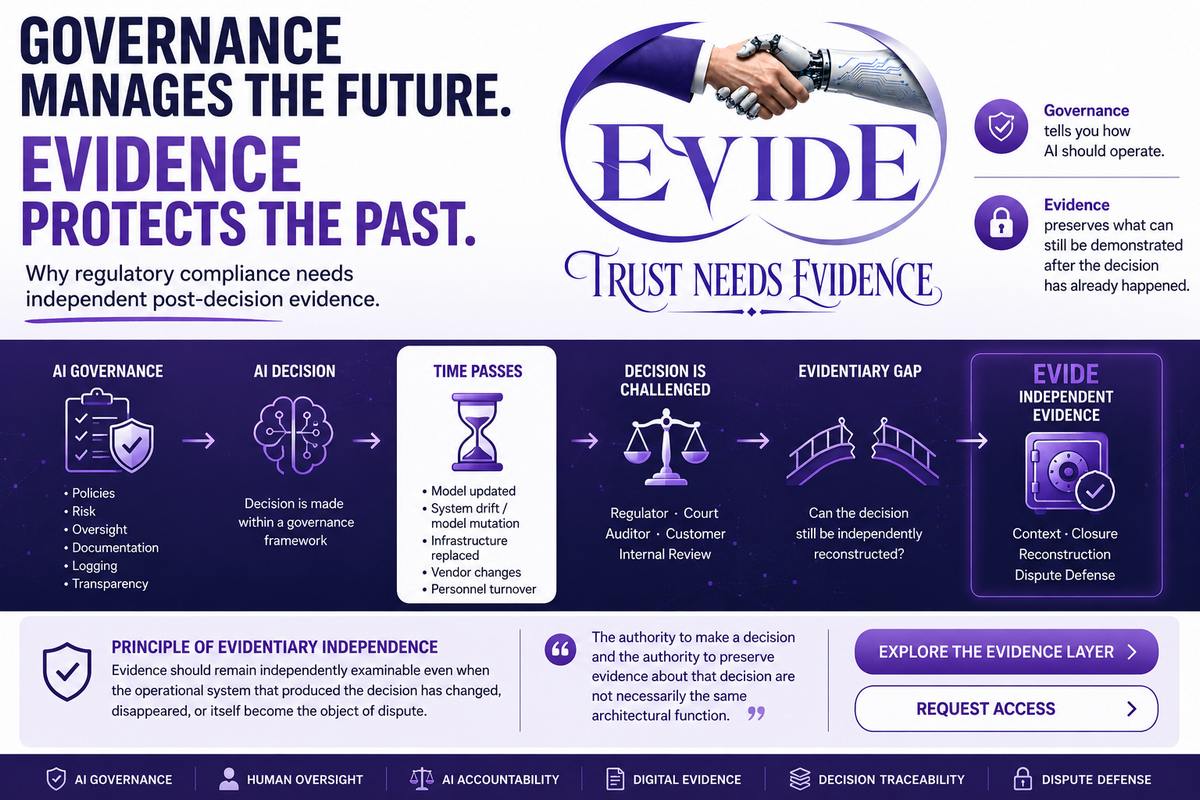
Governance tells you how AI should operate.
Evidence preserves what can still be demonstrated after the decision has already happened.
Why regulatory compliance needs independent post-decision evidence.
Most discussions about AI governance focus on how systems should behave.
This page focuses on a different question.
When the decision is challenged
Something unusual happens when an AI-influenced decision is disputed.
The discussion is no longer about model accuracy. It is no longer about benchmarks. It is no longer about prompt engineering.
It becomes a completely different conversation. Can the organization demonstrate:
- what information existed at that moment?
- who reviewed the decision?
- which governance rules were active?
- which taxonomy was being applied?
- whether uncertainty had already been identified?
- whether the decision context still exists today?
If those answers depend entirely on the operational system that produced the decision, the discussion immediately becomes more difficult.
Evidence begins where execution ends.
Governance manages the future. Evidence protects the past.
The governance problem
Organizations deploying AI systems are increasingly required to govern them: policies, risk assessments, technical documentation, human oversight procedures, logging, transparency disclosures. Across jurisdictions - the EU AI Act, the NIST AI Risk Management Framework, sector-specific regulators, internal corporate governance frameworks - the expectation is converging on the same demand: AI-influenced decisions must be governed, documented, and supervised.
This is necessary. It is also not sufficient.
The evidentiary gap
Governance frameworks define what should happen. Logs and internal documentation record that something happened. Neither, on its own, can demonstrate - independently and verifiably, months or years later - that a specific decision was made within a defined structure, by an identified authority, under conditions that were stable at the moment the decision closed.
This is the evidentiary gap. It becomes visible only when a decision is challenged: in a regulatory inquiry, a legal dispute, an internal investigation, or an audit conducted long after the system that produced the decision has moved on, been updated, or been decommissioned.
EVIDE is an external evidence layer designed to preserve the evidentiary context of AI-influenced decisions after execution. It does not operate inside the AI runtime, does not enforce governance policies, and does not determine whether a decision was correct. Its purpose is to preserve what can later be independently examined. It complements governance frameworks by preserving evidentiary continuity without becoming part of the operational decision process.
EVIDE acts as a non-intrusive, independent composition layer. Any system capable of emitting a structured governance artifact can anchor its evidence to EVIDE - without ceding authority, without direct integration, and without architectural dependency.
Typical dispute scenarios
A customer disputes an automated fraud assessment. Months later: can the exact evidentiary context still be reconstructed? Can the organization detect a silent governance degradation - where cumulative overrides effectively inverted the initial risk framework - at the moment the decision closed?
A clinical recommendation is questioned after treatment. Can investigators reconstruct exactly what was known when the recommendation closed?
A candidate claims discrimination. Can the organization demonstrate governance state, oversight, thresholds and taxonomy - without rebuilding the whole environment? Can it prove that human oversight remained meaningful, and was not compressed under high decision volume?
A credit decision is challenged. Can the evidentiary record survive independently from the original platform?
The lifecycle of a decision
AI Act as the clearest example
The EU AI Act is currently one of the clearest examples of this shift. For high-risk AI systems, it requires risk management, technical documentation, automatic record-keeping, human oversight, and transparency toward deployers. Under the Digital Omnibus on AI - the targeted amendment agreed by the Council and Parliament in 2026 - the applicable deadline for standalone high-risk systems under Annex III was deferred to 2 December 2027, with high-risk systems embedded in regulated products under Annex I following on 2 August 2028.
These requirements describe how an AI system should be designed, deployed, and supervised. But when an AI-influenced decision is challenged, the question shifts from was the system compliant to can this specific decision be independently reconstructed and defended.
The AI Act establishes governance obligations. It does not prescribe a specific independent evidentiary mechanism for preserving post-decision context.
Questions you may be asked during a dispute
| During a dispute... | Typical governance answer | Independent evidentiary record |
|---|---|---|
| Can we prove who reviewed the decision? | Policy says a reviewer should exist. | Reviewer identity, independently preserved. |
| Can we prove which taxonomy was active? | The current taxonomy is available. | The taxonomy actually used at decision closure. |
| Can we prove threshold authority? | Internal configuration documents it. | Threshold continuity, preserved externally at closure. |
| Can we reconstruct the decision after the system changes? | Depends on internal retention policy. | A record that exists outside the system and survives it. |
Evidence should remain independently examinable even when the operational system that produced the decision has changed, disappeared, or itself become the object of dispute.
The authority to make a decision and the authority to preserve evidence about that decision are not necessarily the same architectural function.
What EVIDE does not do
EVIDE must not be confused with a compliance tool or a legal guarantee.
- EVIDE does not certify compliance with the AI Act, NIST AI RMF, or any other regulatory framework
- EVIDE does not replace legal assessment or legal advice
- EVIDE does not replace technical documentation required by applicable regulation
- EVIDE does not replace the AI system's own logs or monitoring
- EVIDE does not operate inside the AI runtime, and does not influence, validate, or modify AI decisions
- EVIDE does not determine whether an AI output was correct - only whether the decision context around it remains independently examinable
- Human oversight, where it occurred, can be preserved as independently examinable evidence - not as a verified guarantee of correctness
Beyond the AI Act
The evidentiary gap is not specific to the EU. The same structural problem exists wherever an AI-influenced decision can later be challenged: under the NIST AI Risk Management Framework in the United States, under sector regulators in financial services and healthcare, under employment and anti-discrimination law, and under internal corporate governance standards that have nothing to do with AI-specific legislation at all.
EVIDE's evidentiary layer is schema-based and jurisdiction-agnostic. The same external record is equally relevant whether the dispute unfolds under EU law, US sectoral regulation, or a private contractual disagreement that never reaches a regulator at all.
Regulations may differ. The evidentiary question remains remarkably similar.
Frequently Asked Questions
No. The AI Act does not require EVIDE or any specific evidentiary product. EVIDE addresses a gap that exists regardless of which framework applies.
No. EVIDE does not certify compliance with the AI Act, NIST AI RMF, or any other regulation. It preserves evidence; it does not issue legal or regulatory certifications.
Because logs are typically generated and maintained by the operational system itself. While they remain essential for governance and operations, they may not, on their own, provide an independently examinable evidentiary context once that operational environment has changed, and may not be sufficient, on their own, to demonstrate the governance context in which a decision was closed. EVIDE decouples the evidentiary layer from the execution layer.
No. Internal logs remain necessary and useful. EVIDE adds an external, independent record that survives changes to the system that produced the logs.
Yes. EVIDE is schema-based and domain-agnostic - it sits alongside existing governance, risk, and compliance platforms rather than replacing them.
No. EVIDE does not operate inside the AI system and does not observe execution in real time. It anchors evidence after a significant decision or event has already been declared.
No. The evidentiary gap EVIDE addresses exists under any regulatory framework, in any jurisdiction, wherever an AI-influenced decision can later be disputed.
Related concepts
Governance helps organizations make responsible decisions. EVIDE helps them demonstrate those decisions when responsibility is later questioned.