What happened
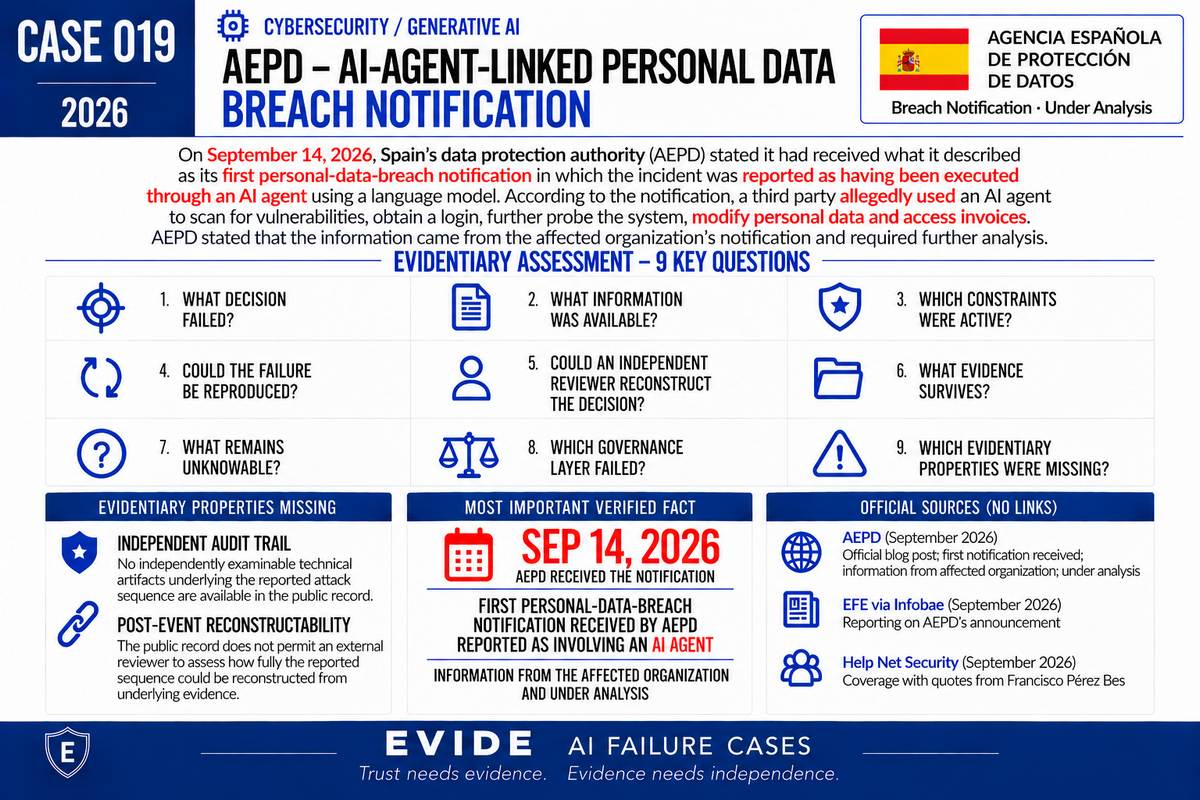
On September 14, 2026, Spain's data protection authority (Agencia Española de Protección de Datos, AEPD) published a blog post stating it had received what it described as its first personal-data-breach notification in which the incident was reported as having been executed through an AI agent using a language model. According to the notification submitted by the affected organization, a third party allegedly used an AI agent as an instrument to chain together stages of an attack: the agent reportedly began by searching for vulnerabilities in generic files, completed a successful login, and, after obtaining access, autonomously searched the application for further vulnerabilities, which allegedly allowed it to modify personal data and access invoices. AEPD explicitly stated, in the same post, that the available information originated from the notification submitted by the affected organization and remained subject to further analysis, and that the use of a specific AI model did not imply that the model or its provider's infrastructure had been compromised, nor that the tool had been designed to carry out malicious activity. AEPD also stated that this single notification did not permit any statistical conclusion, describing it instead as a signal that AI-supported attacks were beginning to materialize in incidents affecting real personal data processing. The affected organization, its industry sector, the specific AI model involved, and the attacker's identity have not been publicly disclosed by AEPD or by any source reviewed. The exact date of the underlying incident has not been publicly established; September 14, 2026 is the date associated with AEPD's public post, not a confirmed date of attack.
Evidentiary Assessment - 9 questions
What decision failed?
No specific decision failure has been established by AEPD in the public record. The available account describes a reported attack sequence attributed to an AI agent used as an instrument by a third party; AEPD has explicitly stated this account originates from the affected organization's own notification and requires further analysis.
What information was available at the time?
Not publicly established. The notification describes the agent's reported actions, vulnerability scanning, a successful login, further probing, data modification, and invoice access, but no information has been published about what technical safeguards, monitoring, or detection capabilities were in place at the affected organization before the incident.
Which constraints were active?
Not publicly established. No public source describes what access controls, credential protections, or monitoring systems were in place on the affected application.
Could the failure be reproduced?
Not assessable from public evidence. No technical details sufficient for reproduction, such as the specific vulnerability exploited or the application involved, have been published.
Could an independent reviewer reconstruct the decision months later?
From the public record, only partially. The technical sequence currently described publicly derives from the affected organization's notification. No underlying logs, agent traces, forensic images, or other independently examinable technical artifacts have been published. The public record does not establish what additional evidence AEPD possesses internally.
What evidence survives?
AEPD's public blog post, and the procedural fact that a breach notification was received. No underlying technical artifacts, such as logs, forensic reports, or agent traces, have been made public. The public record does not establish what materials, beyond this post, the authority holds internally.
What remains unknowable?
The identity of the affected organization; its industry sector; the identity of the alleged attacker; the specific AI model or provider involved; the agent framework used; the precise tool permissions available to the agent; the duration of the attack; the number of affected data subjects; the precise categories of personal data involved beyond what is described; the extent of human-in-the-loop control during the incident; and which specific actions were directly instructed by the human operator versus autonomously selected by the agent.
Which governance layer failed?
Decision & Evidence - Primary Governance Layer Under Examination. This classification reflects the evidentiary question this case raises for the repository, not a finding by AEPD: what evidence supports attributing the reported attack sequence to an AI agent, and how independently reconstructable is that attribution? AEPD has not stated that any governance layer failed in this incident.
Which evidentiary properties were missing?
Independent Audit Trail and Post-Event Reconstructability: no independently examinable technical artifacts underlying the reported attack sequence are available in the public record. The public record therefore does not permit an external reviewer to assess whether an independent audit trail exists or how fully the reported sequence could be reconstructed from underlying evidence.