What happened
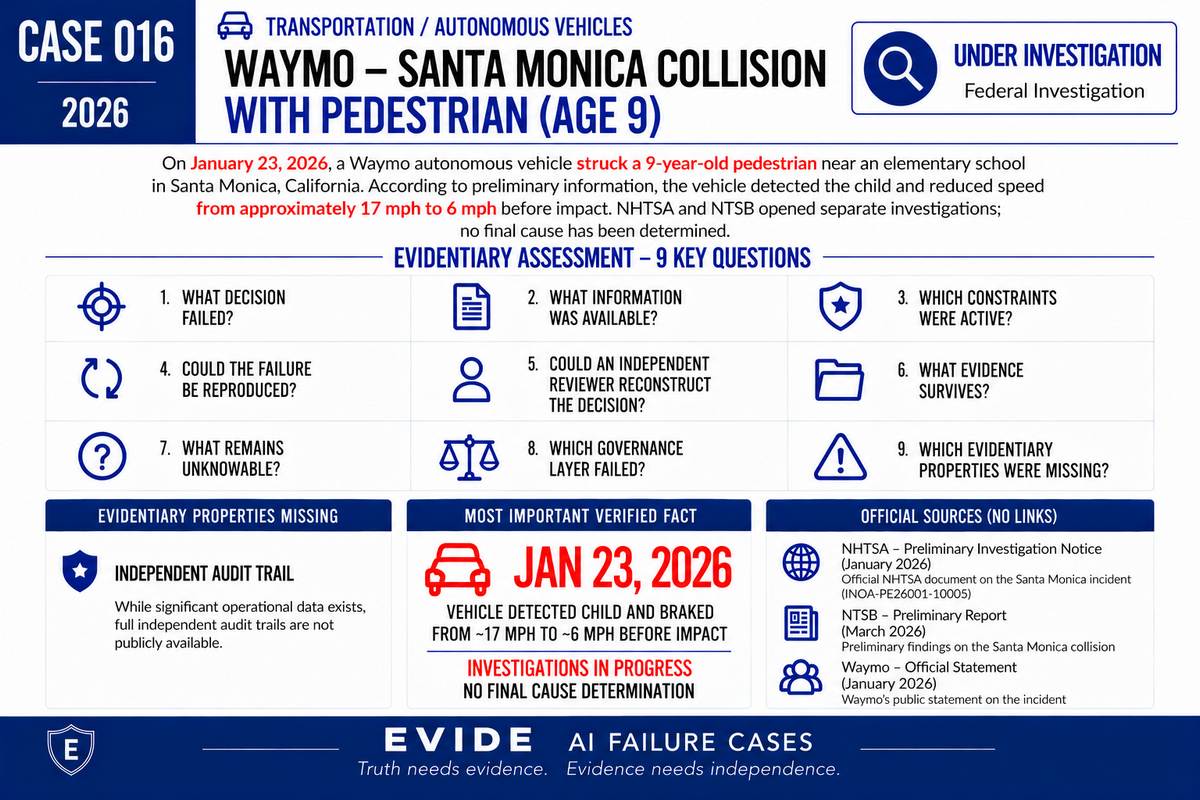
On January 23, 2026, a Waymo autonomous vehicle - a Jaguar I-Pace operating on Waymo's fifth-generation Automated Driving System with no human safety supervisor on board - struck a 9-year-old child near an elementary school in Santa Monica, California, during morning drop-off hours, in an area with a crossing guard, other children, and double-parked vehicles nearby. According to NTSB's preliminary report, the vehicle detected the child and braked, reducing its speed from approximately 17 mph to approximately 6 mph before impact. The child fell, then walked to the curb; she was treated for minor injuries and did not require medical transport. Waymo reported the incident to NHTSA the same day and filed the report required under Standing General Order 2021-01 on January 28, 2026. Both NHTSA's Office of Defects Investigation and the National Transportation Safety Board opened separate investigations, the latter announced the same day as the collision. NTSB's preliminary report, released in March 2026, states that investigators did not find evidence that the vehicle behaved recklessly - an explicitly preliminary finding, with a more detailed final report expected 12 to 24 months after the investigation opened. NHTSA sent Waymo a detailed set of questions on March 23, 2026; Waymo requested an extension to respond in a letter dated May 1, 2026, and document production was still ongoing as of August 2026. This investigation is separate from, and should not be confused with, unrelated NHTSA and NTSB investigations into Waymo vehicles failing to stop for stopped school buses in multiple cities - those investigations involve different incidents and were opened on different timelines (NHTSA in October 2025, NTSB on January 26, 2026) and are not formally linked to the Santa Monica collision.
Evidentiary Assessment - 9 questions
What decision failed?
No final causal determination has been made public. The vehicle detected the child and braked before impact; whether that response reflects a system that functioned as designed but could not avoid the collision, or a system that should have responded earlier, has not been established by either investigating agency.
What information was available at the time?
According to NTSB's preliminary report, the vehicle's sensors detected the child crossing the street from behind a double-parked vehicle and initiated braking, reducing speed from approximately 17 mph to approximately 6 mph before impact. What broader contextual signals - proximity to a school, presence of a crossing guard, time of day - the system's decision-making incorporated has not been publicly detailed.
Which constraints were active?
Not established from public sources. Neither agency's public materials to date specify what speed limits, geofencing, or behavioral constraints Waymo's system applies specifically in school-zone contexts.
Could the failure be reproduced?
Cannot be determined from public evidence. The exact sensor data, perception outputs, and decision logic active in the seconds before the collision have not been published.
Could an independent reviewer reconstruct the decision months later?
Partially. NTSB and NHTSA, as federal agencies with investigative and document-production authority, have access to material that a private, independent reviewer could not otherwise obtain. NHTSA's detailed questions to Waymo (March 23, 2026) and the subsequent document production suggest a fuller reconstruction is possible, but the underlying materials are not yet public and the final reports from both agencies remain pending.
What evidence survives?
NHTSA's Office of Defects Investigation filing (publicly posted), Waymo's SGO 2021-01 report, NTSB's preliminary report, and public reporting on the correspondence between NHTSA and Waymo, including Waymo's extension request and subsequent document handover.
What remains unknowable?
The final causal determination from either agency, which is not yet published; the complete content of Waymo's responses to NHTSA's questions; and whether the vehicle's speed and response in that specific school-zone context met Waymo's own internal safety standards, which have not been made public.
Which governance layer failed?
Safety & Boundary Controls - Primary Governance Layer Under Examination. The event is documented in detail, including the vehicle's detection and braking response, but the failure mechanism, if any, is not yet finally established by either investigating authority.
Which evidentiary properties were missing?
Independent Audit Trail for the vehicle's full sensor and decision log in this specific encounter. The closest available approximation to independent scrutiny comes from two federal agencies with distinct investigative mandates, whose final findings remain pending.