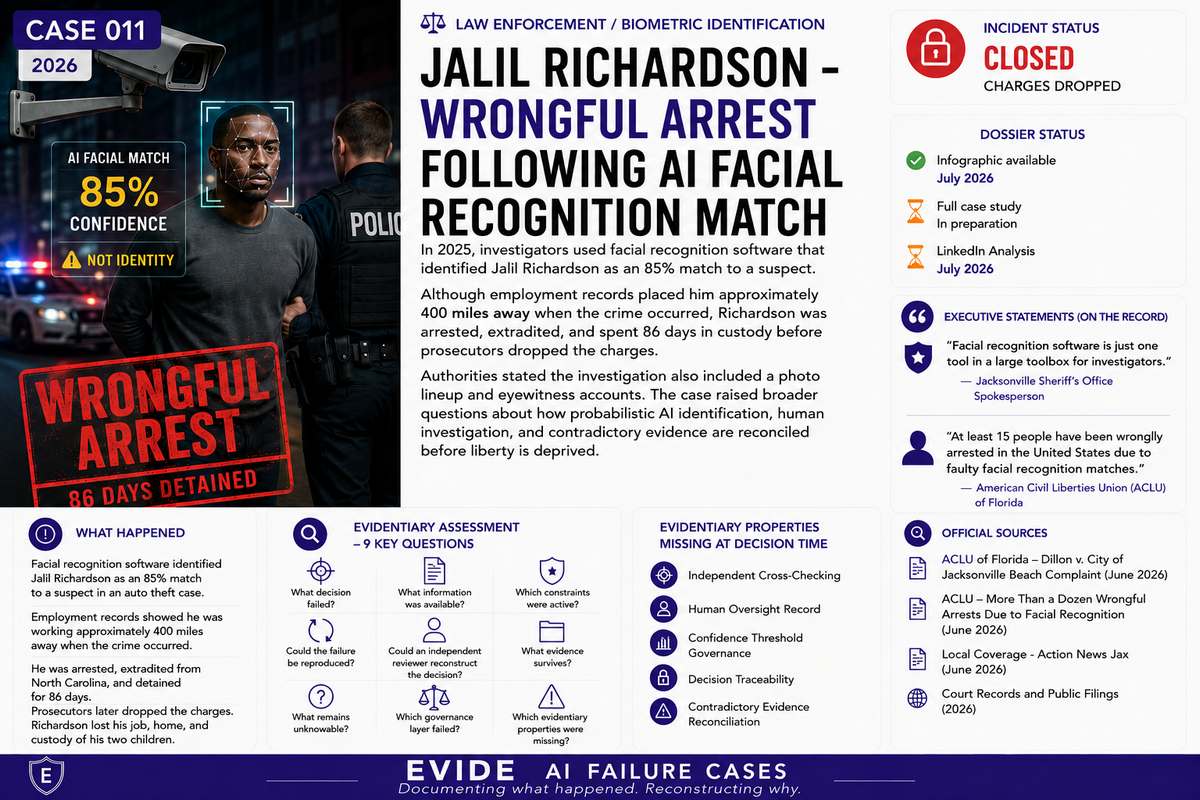
What happened
On April 2, 2025, a victim reported a stolen vehicle to the Jacksonville Sheriff's Office (JSO) in Florida. Investigators ran surveillance footage through facial recognition software, which flagged Jalil Richardson, of Charlotte, North Carolina, as an 85 percent match. Richardson lived approximately 400 miles away, and his employer's time cards showed he was at work in North Carolina when the vehicle was being sold in Jacksonville. JSO has stated the arrest was not based on the facial recognition match alone: the victim also selected Richardson from a photographic lineup, and investigators cited two eyewitness accounts. Richardson was arrested in North Carolina, held there for 33 days, then extradited to Jacksonville and held for another 53 days - 86 days in total - before prosecutors dropped the charges in mid-2026. The case became publicly known in June 2026 through Action News Jax and was subsequently cited by the ACLU as a documented example in litigation filed on behalf of Robert Dillon, a separate individual wrongfully arrested by JSO through the same facial recognition process.
Evidentiary Assessment - 9 questions
What decision failed?
The decision to arrest and extradite based on a probabilistic facial recognition match combined with an eyewitness lineup identification, without independently reconciling readily available contradictory evidence - Richardson's location and employment records - before depriving him of liberty.
What information was available at the time?
Employment time cards, Richardson's home address roughly 400 miles from the crime scene, and the facial recognition system's own confidence score (85 percent, not a certain match). This information existed before the arrest and extradition were carried out.
Which constraints were active?
Unknown in detail. JSO has stated facial recognition is treated as an investigative lead rather than sole grounds for arrest, and that a photo lineup and eyewitness identification were also used - but no externally verifiable record shows what threshold or verification step was supposed to reconcile the 85 percent match against Richardson's location evidence before an arrest was authorized.
Could the failure be reproduced?
Partially. The surveillance footage and facial recognition search may survive, but the internal reasoning that weighed the AI match and lineup identification against contradictory location evidence cannot be independently reconstructed from public records.
Could an independent reviewer reconstruct the decision months later?
Only partially. Charges were dropped rather than adjudicated, so no court ruling documents the investigative reasoning. JSO's public statement offers a partial account, but the internal decision process that authorized extradition despite the time-card evidence remains largely opaque.
What evidence survives?
Action News Jax's reporting (including Richardson's own account), JSO's official public statement, Richardson's employment time cards, and the ACLU's references to the case in materials related to the Dillon litigation. No court ruling exists for Richardson's case specifically, since charges were dropped rather than tried.
What remains unknowable?
Why the time-card and location evidence did not interrupt the arrest and extradition process earlier, how investigators weighed the 85 percent confidence score against that evidence, and what internal review, if any, occurred before extradition was pursued.
Which governance layer failed?
The Independent Evidence Reconciliation layer. Multiple identification signals (the AI match, the lineup identification, eyewitness accounts) were treated as mutually reinforcing without a documented, independent check against readily available contradictory evidence before liberty was deprived.
Which evidentiary properties were missing?
Independent cross-checking of contradictory evidence, documented human oversight of the identification-to-arrest decision, confidence-threshold governance for probabilistic matches, and decision traceability for why extradition proceeded despite available exculpatory records.