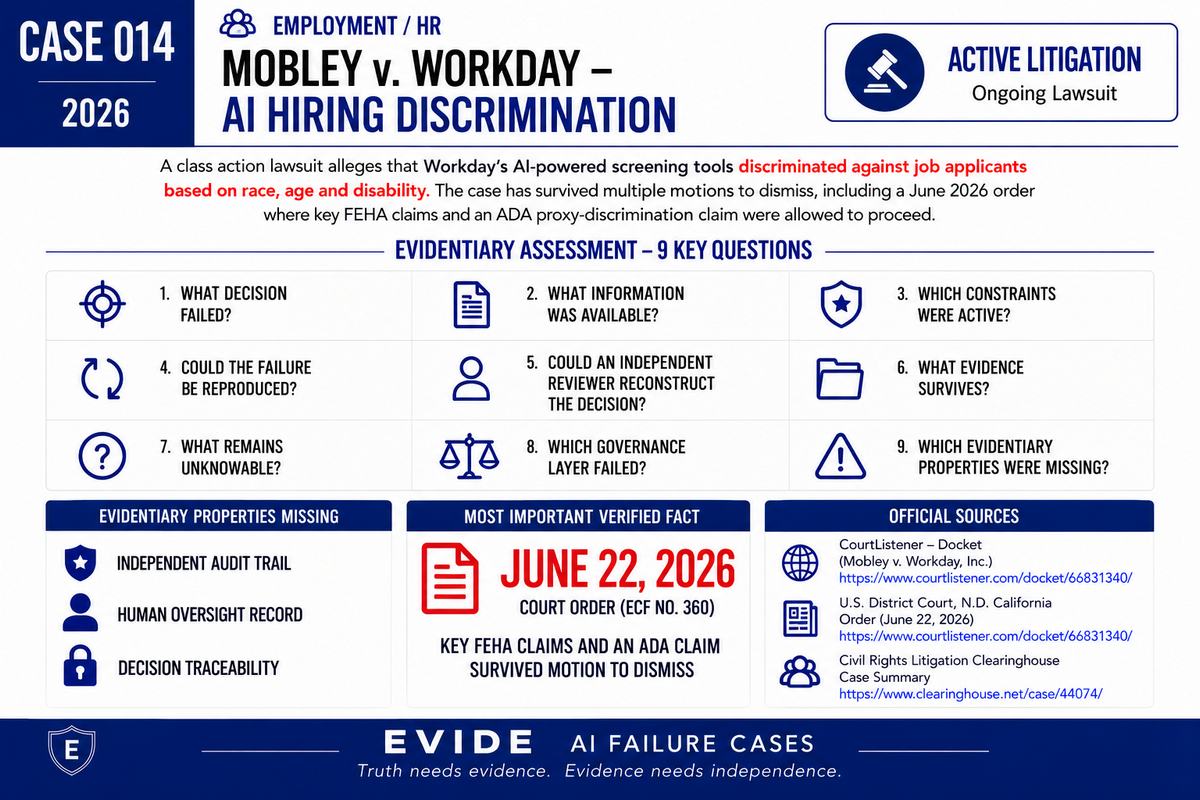
What happened
Derek Mobley filed a lawsuit against Workday, Inc. on February 21, 2023, in the U.S. District Court for the Northern District of California (No. 3:23-cv-00770), alleging that Workday's AI-powered applicant-screening tools discriminated against him and similarly situated applicants on the basis of race, age, and disability. Mobley alleges he was rejected from more than 100 positions at companies using Workday's platform, often within minutes or during overnight hours, which he interprets as evidence of automated rejection without human review. The court has rejected Workday's argument that it is merely a neutral software vendor, finding it plausible that Workday acts as an "agent" of its customers by performing screening and rejection functions on their behalf - a procedural ruling on whether the case can proceed, not a finding that discrimination occurred. A nationwide collective action under the Age Discrimination in Employment Act was certified in 2025. On June 22, 2026, Judge Rita F. Lin denied in part Workday's motion to dismiss the operative complaint, allowing California Fair Employment and Housing Act claims and one plaintiff's disability-based proxy-discrimination claim to proceed, while dismissing certain race-based claims on procedural grounds. Workday disputes the allegations and continues to contest the case, which remains in active litigation with no finding on the merits.
Evidentiary Assessment - 9 questions
What decision failed?
No governance failure has been judicially established. Plaintiffs allege that Workday's automated screening process filtered out qualified applicants based on protected characteristics without adequate human review. Workday disputes this characterization and maintains it provides screening tools, not discriminatory outcomes.
What information was available at the time?
According to the complaint, applicants submitted standard job application materials into Workday-powered systems used by its corporate customers. Mobley alleges that rejections often occurred within minutes or during overnight hours, which he interprets as an absence of human review. The complaint does not establish exactly what information the screening algorithms used to reach match or rejection decisions.
Which constraints were active?
Not publicly established. Neither the complaint nor the court's rulings to date describe the specific screening criteria, weighting, or human-review checkpoints Workday's customers had configured for their use of the platform.
Could the failure be reproduced?
Cannot be independently determined from available public evidence. The scoring logic, model configuration, and customer-specific settings behind any individual applicant's rejection are not publicly documented, and the case remains in discovery.
Could an independent reviewer reconstruct the decision months later?
Partially, and primarily through compulsory discovery rather than public information. A 2025 order compelling Workday to identify which customers had enabled HiredScore AI features suggests that a detailed reconstruction may only become possible through litigation-driven disclosure, not from information available to an outside observer at the time of an individual rejection.
What evidence survives?
The public docket, including the original and amended complaints, Workday's motions to dismiss, and the court's orders (including the June 22, 2026 order on the operative complaint), is available via the federal court's electronic filing system. The underlying screening algorithm's design, training data, and decision logs are not publicly available.
What remains unknowable?
Whether Workday's tools in fact produced discriminatory outcomes for any specific applicant; what proxies, if any, the algorithms relied upon; and whether adequate human review existed at any stage. These are the central disputed questions the litigation itself is meant to resolve, and no public source currently answers them.
Which governance layer failed?
Decision & Evidence - Primary Governance Layer Under Examination. The central dispute concerns whether the screening process can be independently reconciled with anti-discrimination law and whether adequate human oversight existed. No court has yet made that determination on the merits.
Which evidentiary properties were missing?
Independent Audit Trail, Decision Traceability, and a Human Oversight Record for the automated screening pipeline - none of which are publicly documented for the systems at issue in this case.