
Emergency Dispatch & Triage
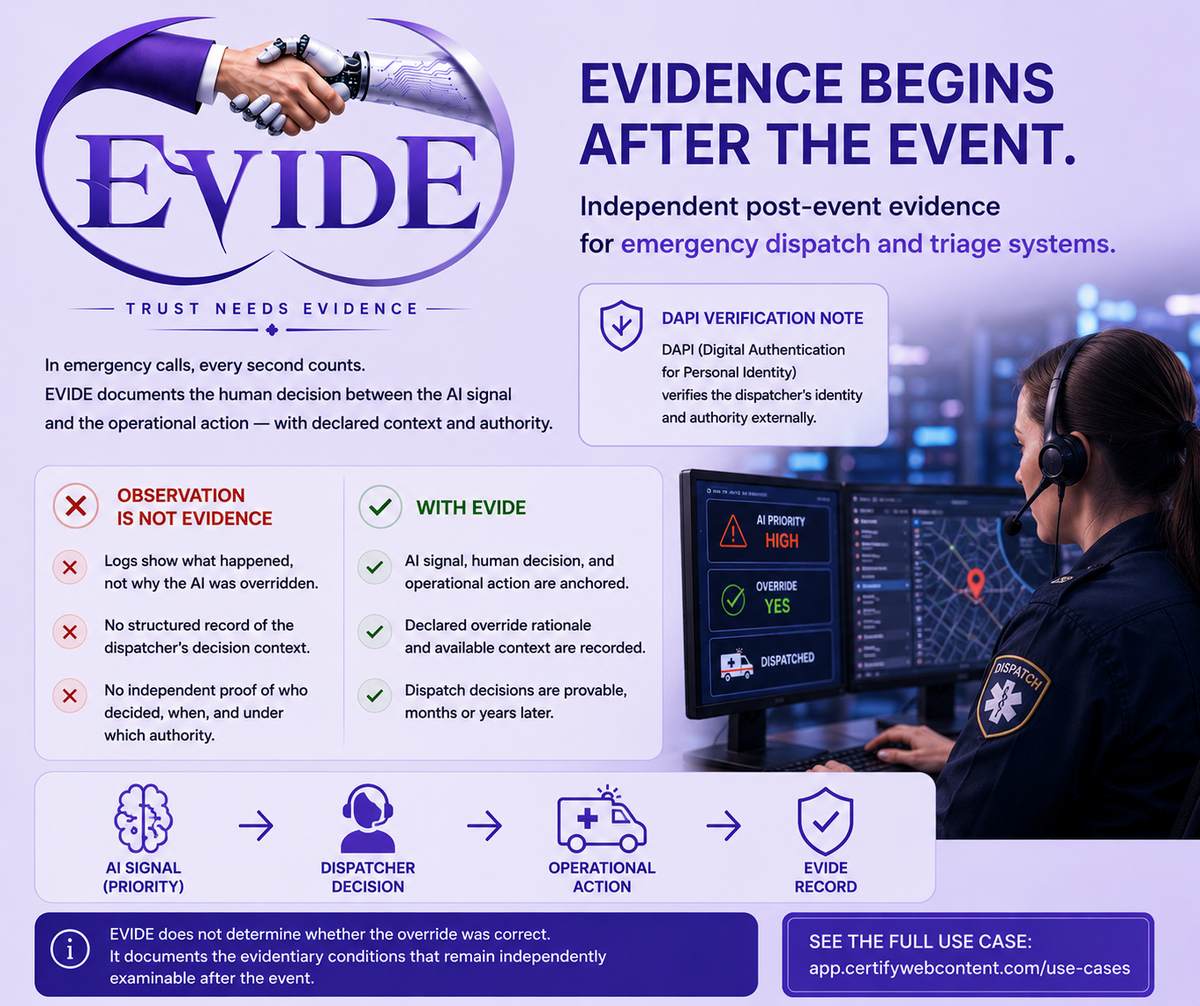
The real chain has not two links but three: the AI-generated signal, the human decision that accepts or modifies it, and the operational action actually executed. Many overrides originate from information that became available only after the AI's initial proposal - a fact that, if not anchored separately, disappears into the after-the-fact narrative.
- The system records the final outcome, without distinguishing the priority originally proposed by the AI from the one actually executed
- If an operator modified the classification, the rationale exists only as internal free text, not structured or externally verifiable
- Information that emerged after the initial proposal (caller disconnected, GPS unavailable, second call received) is not distinguished from the original context - the true cause of the override remains invisible
- Vendor, dispatch center, and field unit each attribute responsibility differently, with no externally verifiable sequence
- The AI-proposed classification and the final human decision are two distinctly anchored objects, not a single merged outcome
- An override carries a free-text rationale (declared_override_rationale) alongside a structured category (override_category) - the latter makes the record queryable at scale without replacing or constraining the operator's exact words
- The context that emerged after the AI proposal (context_available_at_decision) remains a separate, reconstructable element, not absorbed into the final narrative
- The declared decision window (declared_decision_window_seconds) remains explicitly labeled as declared, not as an independently measured technical time
- 1 What priority had the AI system actually proposed, before any human intervention?
- 2 What information became available after the AI's proposal, and before the final decision?
- 3 Did the human decision confirm, modify, or ignore the proposal - with what declared rationale, in free text and by category?
- 4 Under what authority and role was the final decision made?
- 5 What decision window was declared as available between proposal and action?
- 6 Do the three timestamps in the record share a declared synchronized time reference?
- 7 Does the operational action executed correspond to the declared decision, or is there a recorded divergence?
- 8 Which protocol version was in effect at the time of the event?
When a dispatcher confirms, modifies, or overrides an AI-generated priority, the declared authority behind that decision carries as much weight as the rationale itself. An internal operator ID or a name typed into a dispatch console declare who acted, but do not confirm it. The authority in the record above carries its own DAPI-verified identity - closing the gap between "an override was declared under this authority" and "we know that authority was real".
DAPI Identity Certification ↑EVIDE does not determine whether the underlying decision was correct, whether applicable procedures were followed, or whether the outcome was legally justified. It documents the evidentiary conditions that remain independently examinable after the event.