
🏥 Healthcare
Healthcare & Clinical Decision Support
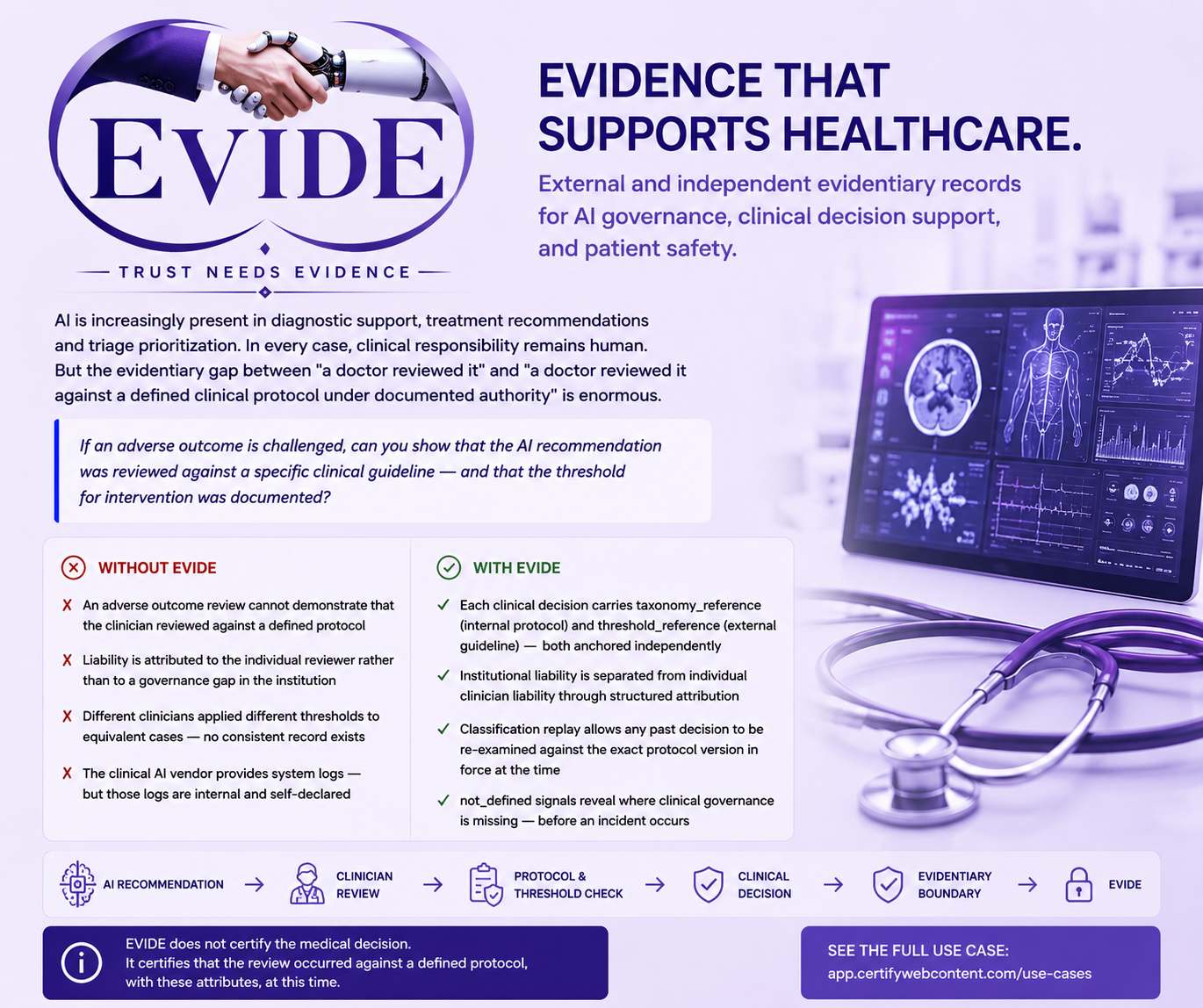
AI is increasingly present in diagnostic support, treatment recommendations and triage prioritization. In every case, clinical responsibility remains human. But the evidentiary gap between "a doctor reviewed it" and "a doctor reviewed it against a defined clinical protocol under documented authority" is enormous.
If an adverse outcome is challenged, can you show that the AI recommendation was reviewed against a specific clinical guideline - and that the threshold for intervention was documented?
Capabilities
● Standard Intake
● External Artifacts
Without EVIDE
- An adverse outcome review cannot demonstrate that the clinician reviewed against a defined protocol
- Liability is attributed to the individual reviewer rather than to a governance gap in the institution
- Different clinicians applied different thresholds to equivalent cases - no consistent record exists
- The clinical AI vendor provides system logs - but those logs are internal and self-declared
With EVIDE
- Each clinical decision carries taxonomy_reference (internal protocol) and threshold_reference (external guideline) - both anchored independently
- Institutional liability is separated from individual clinician liability through structured attribution
- Classification replay allows any past decision to be re-examined against the exact protocol version in force at the time
- not_defined signals reveal where clinical governance is missing - before an incident occurs
Example evidentiary record for healthcare and clinical decision support
A real, API-conformant payload example - verified against the EVIDE intake schema v2.1.
{
"evide_schema": "2.1",
"source_system": "ClinicalDecisionSupportPlatform",
"source_reference": "EVT-2026-0611-0805",
"source_timestamp_utc": "2026-06-11T08:05:44Z",
"decision": {
"type": "clinical_decision",
"status": "finalized",
"closure_timestamp_utc": "2026-06-11T08:05:44Z",
"summary": "Declared clinical review completed following AI-assisted diagnostic support recommendation"
},
"authority": {
"id": "clinician_reviewer_31",
"role": "Attending Clinician",
"dapi_number": "DAPI-XXXX",
"verification": "DAPI-XXXX"
},
"intervention": {
"type": "declared_event",
"classification_status": "stable",
"classification_context": {
"taxonomy_reference": "https://example.org/taxonomies/internal-clinical-protocol-v1.6",
"threshold_reference": "https://example.org/guidelines/external-clinical-guideline-2025-ref",
"threshold_status": "met"
},
"rationale": "AI-assisted recommendation reviewed against internal protocol and external clinical guideline; intervention threshold met",
"trace": {
"reference": "HEALTH-019/case-review-20260611-0805",
"access": "restricted"
}
},
"human_oversight": {
"is_declared": true,
"declared_level": "L1"
},
"handoff": {
"boundary_readiness": {
"status": "candidate",
"readiness_gate": null,
"visibility_surface": null,
"unresolved_signals": []
},
"reconstruction_independence": "declared",
"submission_status": "not_submitted",
"acceptance_status": "not_claimed"
},
"extensions": ["evidence_references"],
"evidence_references": [
{
"artifact_type": "dicom",
"pointer": "pacs://study/1.2.840.113619.2.55.3.604688119.868",
"declared_origin": "hospital PACS system",
"declared_description": "Diagnostic imaging study reviewed against the clinical guideline",
"hash": {
"algorithm": "SHA-256",
"value": "sha256:2f84a1...b573_example_not_for_submission"
},
"hash_scope": "full_file",
"hashed_by": "PACS export utility"
}
],
"content_hash": {
"algorithm": "SHA-256",
"value": "sha256:9f47...b620_example_not_for_submission"
}
}