What happened
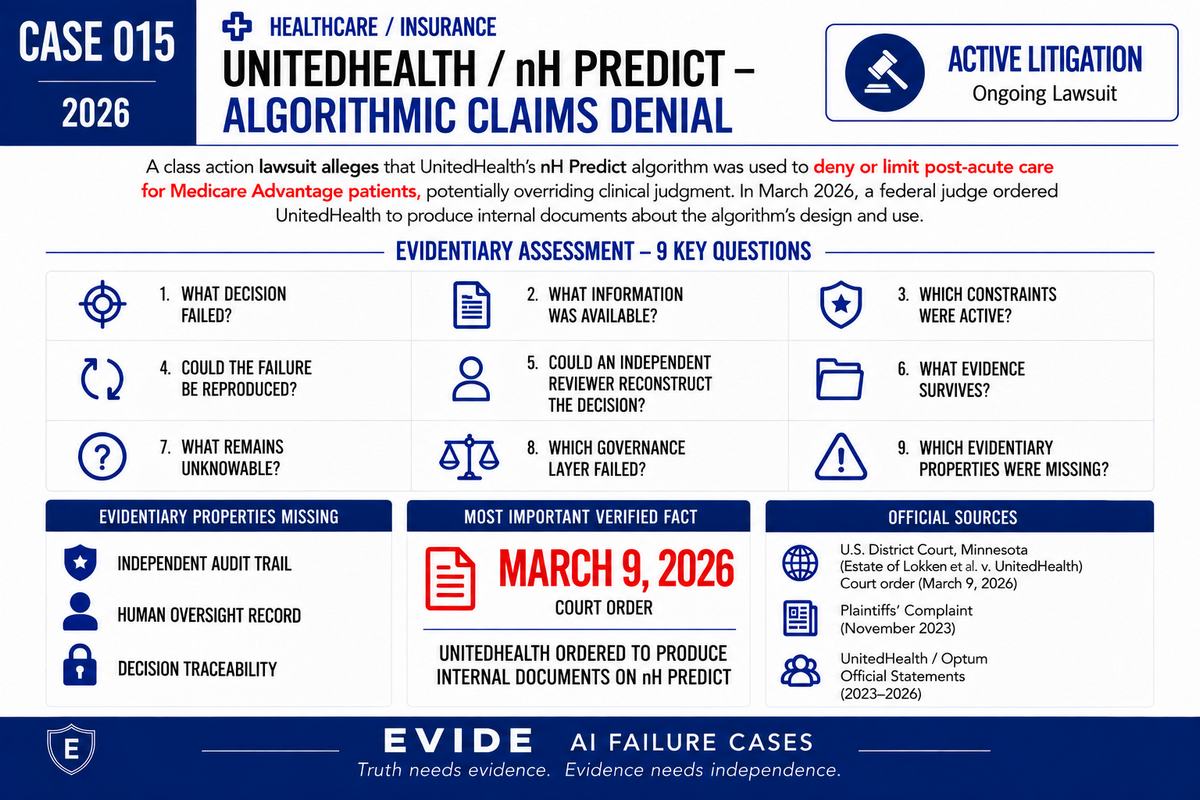
In November 2023, the families of two deceased Medicare Advantage beneficiaries filed a class action, Estate of Gene B. Lokken et al. v. UnitedHealth Group, Inc. et al., in the U.S. District Court for the District of Minnesota. The complaint alleges that UnitedHealth Group, UnitedHealthcare, and its subsidiary naviHealth (now Home & Community Care) used an algorithmic tool called nH Predict to estimate how much post-acute care Medicare Advantage patients would need, and that the company relied on those predictions to terminate coverage prematurely, overriding treating physicians' judgment. The complaint cites a STAT News investigation alleging an approximately 90 percent rate at which appealed denials were later reversed, and alleging that UnitedHealth set internal targets tied to nH Predict's predicted length of stay. Optum, UnitedHealth's subsidiary, has publicly and repeatedly stated that nH Predict is not used to make coverage determinations, and that medical necessity decisions are made by physicians following guidance from the Centers for Medicare & Medicaid Services. An earlier ruling on UnitedHealth's motion to dismiss allowed breach-of-contract and breach-of-the-implied-covenant claims to proceed, while dismissing other claims on Medicare Advantage preemption grounds. On March 9, 2026, a federal magistrate judge ordered UnitedHealth to produce internal documents across six of seven requested discovery categories, while denying requests for nH Predict's source code and the underlying medical guidelines. The case remains in active litigation, with no judicial finding on whether nH Predict displaced clinical judgment.
Evidentiary Assessment - 9 questions
What decision failed?
No governance failure has been judicially established. Plaintiffs allege that coverage decisions were effectively driven by an algorithmic prediction rather than individualized clinical assessment. Optum disputes this characterization and maintains that medical necessity determinations are made by physicians, with nH Predict serving only as a planning guide.
What information was available at the time?
According to the complaint, nH Predict generated length-of-stay predictions based on comparisons with other patients' health records. The complaint alleges, citing a STAT News investigation, that internal targets tied case managers' evaluations to how closely actual patient stays matched nH Predict's predictions. Optum has not confirmed this specific allegation.
Which constraints were active?
Not established from public sources. Neither the complaint nor the discovery order made public to date describes what override authority treating physicians or care coordinators had, in practice, over an nH Predict prediction.
Could the failure be reproduced?
Cannot be determined from public evidence. The court's March 2026 order specifically excluded nH Predict's source code and underlying medical guidelines from discovery, meaning even litigation-compelled disclosure will not make the tool's internal logic independently reproducible on the current record.
Could an independent reviewer reconstruct the decision months later?
Partially, and increasingly through compulsory disclosure rather than public information. Before the March 2026 discovery order, the primary public record consisted of the complaint's allegations and the STAT News investigation it cites. The order compels UnitedHealth to produce internal documents across most requested categories, which may allow a more complete reconstruction - but that material is not yet public, and the tool's source code remains outside the scope of what has been ordered disclosed.
What evidence survives?
The public docket in the District of Minnesota, Optum's repeated public statements characterizing nH Predict as a non-determinative guide, the STAT News investigation cited in the complaint, and public reporting describing which categories of internal documents the March 9, 2026 order requires UnitedHealth to produce.
What remains unknowable?
Whether nH Predict's predictions in fact drove the coverage decisions at issue for the named plaintiffs' family members; whether the alleged internal performance targets existed in the form described in the complaint; and the tool's internal logic, which has been explicitly excluded from the discovery ordered so far.
Which governance layer failed?
Decision & Evidence - Primary Governance Layer Under Examination. The dispute centers on whether an algorithmic tool displaced or merely informed the clinical judgment that coverage policies promised. No court has resolved this factual dispute on the merits.
Which evidentiary properties were missing?
Independent Audit Trail, Decision Traceability, and Human Oversight Record for the specific coverage decisions at issue - none of which are publicly documented, and some elements of which (such as the tool's source code) have been explicitly excluded even from court-ordered discovery.