
← All AI Failure Cases
 ← All AI Failure Cases
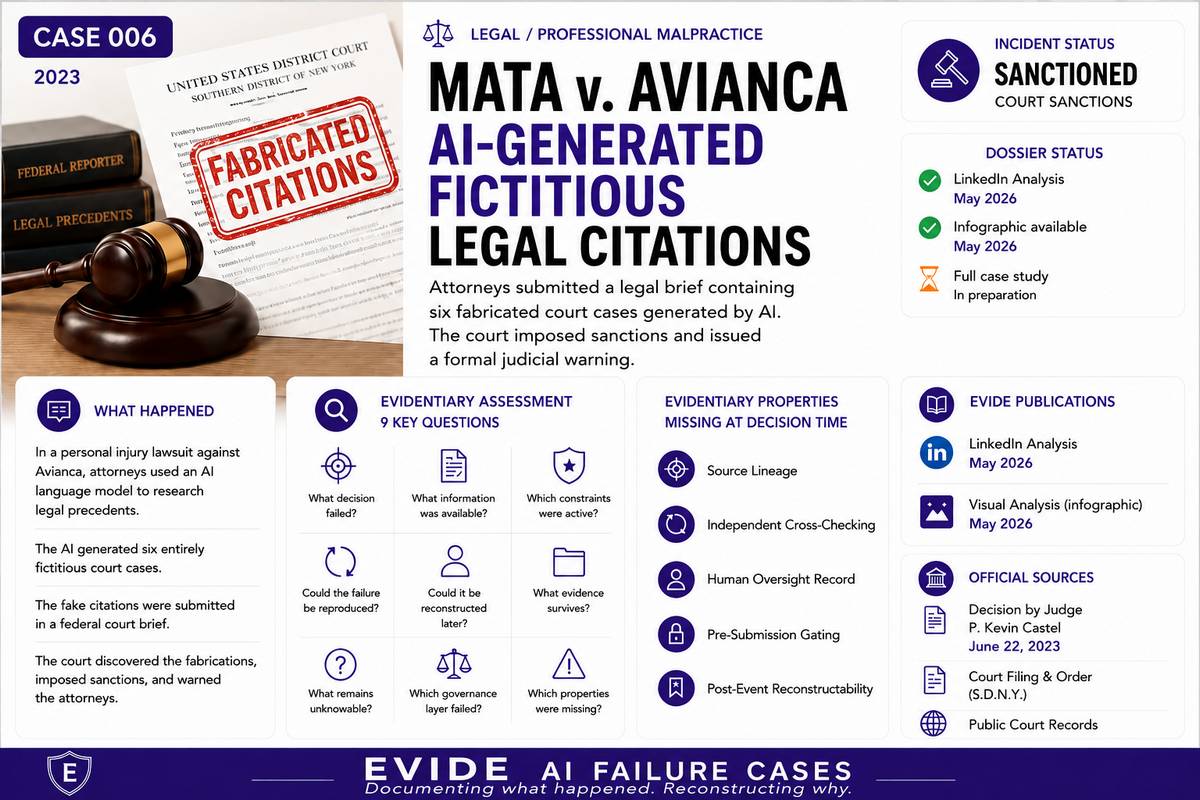
Mata v. Avianca - AI-Generated Fictitious Legal Citations
Incident status
Closed · Judicial Sanctions
Dossier status
⏳ LinkedIn Analysis
⏳ Infographic available
⏳ Full case study
What happened
Attorneys representing Roberto Mata in a personal injury lawsuit against Avianca used ChatGPT for legal research. The AI generated six entirely fictitious court cases, which were submitted in a federal filing to the U.S. District Court for the Southern District of New York. When opposing counsel flagged the anomalies, the attorneys initially defended the citations. On June 22, 2023, Judge P. Kevin Castel sanctioned the attorneys $5,000 for submitting fabricated precedents and acting in subjective bad faith - establishing the first formal judicial precedent on AI hallucination in legal proceedings.
Evidentiary Assessment - 9 questions
What decision failed?
The legal research and citation verification process — the attorneys relied on AI-generated output without independent verification against actual court registries before submitting to a federal court.
What information was available at the time?
Official legal databases (Westlaw, LexisNexis, PACER) contained the true corpus of federal case law. The AI had no live connection to those registries and generated citations based on probabilistic pattern completion.
Which constraints were active?
None that were verifiable. No retrieval-augmented generation constraints existed to verify generated citations against live legal databases before output.
Could the failure be reproduced?
No. The exact token probability states and context window configuration that caused the model to invent Varghese v. China Southern Airlines and five other cases cannot be reconstructed without the original session logs.
Could an independent reviewer reconstruct the decision months later?
No. No structured evidentiary record of the AI research session was preserved. The attorneys' only documentation was the final filing — not the intermediate AI output that generated it.
What evidence survives?
The SDNY public docket (Case No. 1:22-cv-01461), the official sanctions order published at 678 F.Supp.3d 443 (June 22, 2023), and the attorneys' written submissions to the court. The AI session logs are not available.
What remains unknowable?
Whether the attorneys genuinely believed the citations were real, and whether the model's confident citation format — complete with volume numbers, page references, and jurisdiction labels — was the primary factor that bypassed human skepticism.
Which governance layer failed?
The Professional Competence layer (ABA Model Rule 1.1). No independent verification step existed between AI output and court submission. The attorneys' duty of candor to the tribunal required verification they did not perform.
Which evidentiary properties were missing?
Source lineage verification, independent cross-checking against primary registries, human oversight record of the research process, and pre-submission validation anchoring.
Evidentiary properties missing at decision time
EVIDE Publications
None published yet.
Related EVIDE Concepts