
← All AI Failure Cases
 ← All AI Failure Cases
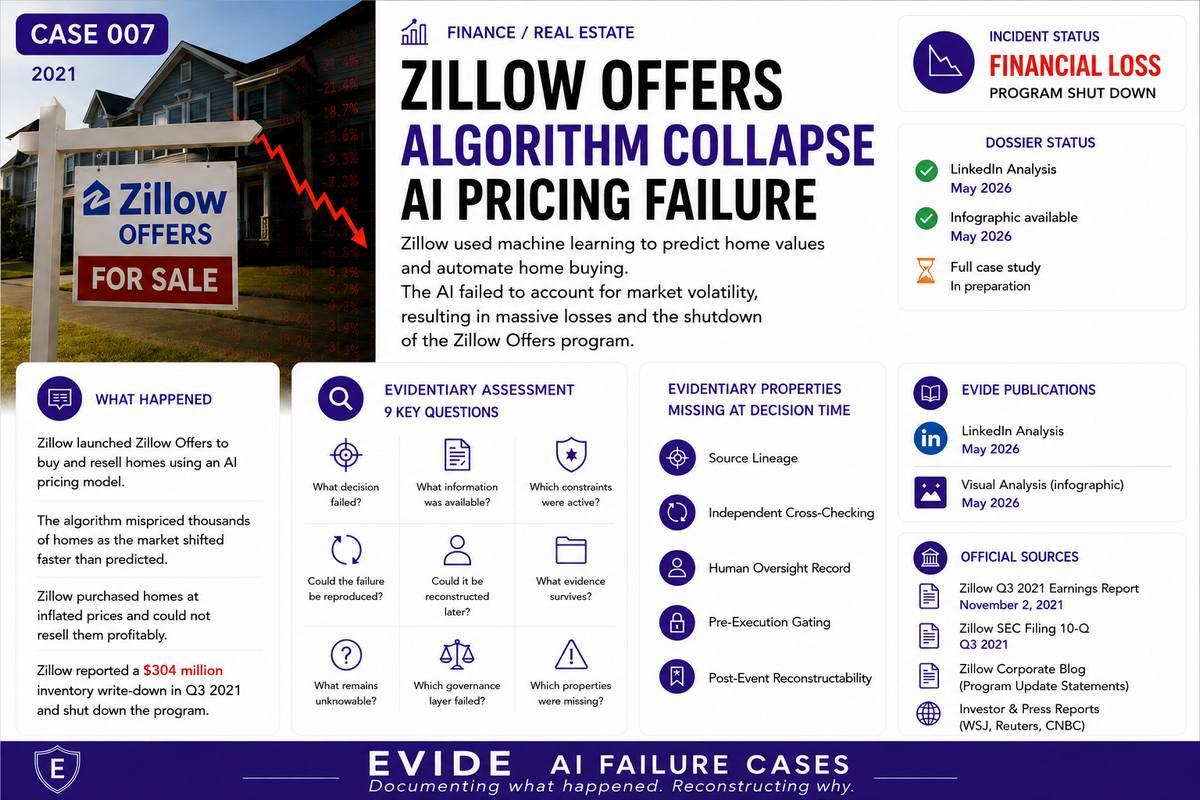
Zillow Offers - AI Algorithmic Collapse in Real Estate iBuying
Incident status
Closed · SEC-Documented
Dossier status
⏳ LinkedIn Analysis
⏳ Infographic available
⏳ Full case study
What happened
Zillow Group deployed an AI-powered algorithm (Zillow Offers / Zestimate) to automate real estate purchases at scale, buying homes directly from sellers based on model price predictions. The algorithm failed to account for housing market volatility and purchasing at inflated prices versus resale values. In Q3 2021, Zillow declared an inventory write-down of $304 million. The total impact exceeded $500 million, resulted in approximately 2,000 layoffs, and forced the complete shutdown of the iBuying unit. The failure was formally disclosed in SEC filings.
Evidentiary Assessment - 9 questions
What decision failed?
Automated property valuation and autonomous purchase decisions at volume — the algorithm was permitted to commit hundreds of millions in capital without real-time human oversight of individual purchase decisions.
What information was available at the time?
Historical housing price data, regional market signals, and macroeconomic indicators. The model was not sufficiently calibrated for the rapid market shifts that occurred in late 2021, and no external governance check constrained purchasing velocity.
Which constraints were active?
Internal model confidence thresholds existed, but no externally anchored boundary constraints prevented the system from continuing to purchase at scale when market distribution shifted beyond training assumptions.
Could the failure be reproduced?
Partially. The market conditions of 2021 are documented. But the exact model state, feature weighting, and confidence thresholds active at each individual purchase decision cannot be independently reconstructed.
Could an independent reviewer reconstruct the decision months later?
No at the individual purchase level. SEC filings document the aggregate outcome and financial impact, but no structured evidentiary record exists of the governance conditions active at each autonomous purchase decision.
What evidence survives?
Zillow Group SEC Form 10-Q for Q3 2021 (filed November 2, 2021) and Form 10-K for fiscal year 2021, both available on SEC EDGAR (CIK: 0001617640). These formally document the inventory write-down, unit shutdown, and workforce reduction.
What remains unknowable?
The exact moment the model's predictions began systematically diverging from market reality, and whether any internal signals existed that were observable but not acted upon before the losses accumulated.
Which governance layer failed?
The Model Risk Management and Boundary Execution layer. No hard constraint prevented the model from continuing autonomous purchasing when distribution drift exceeded safe operational parameters.
Which evidentiary properties were missing?
Real-time model drift detection anchoring, autonomous decision boundary constraints, external governance record of purchase velocity controls, and decision reconstructability at transaction level.
Evidentiary properties missing at decision time
EVIDE Publications
None published yet.
Related EVIDE Concepts