What happened
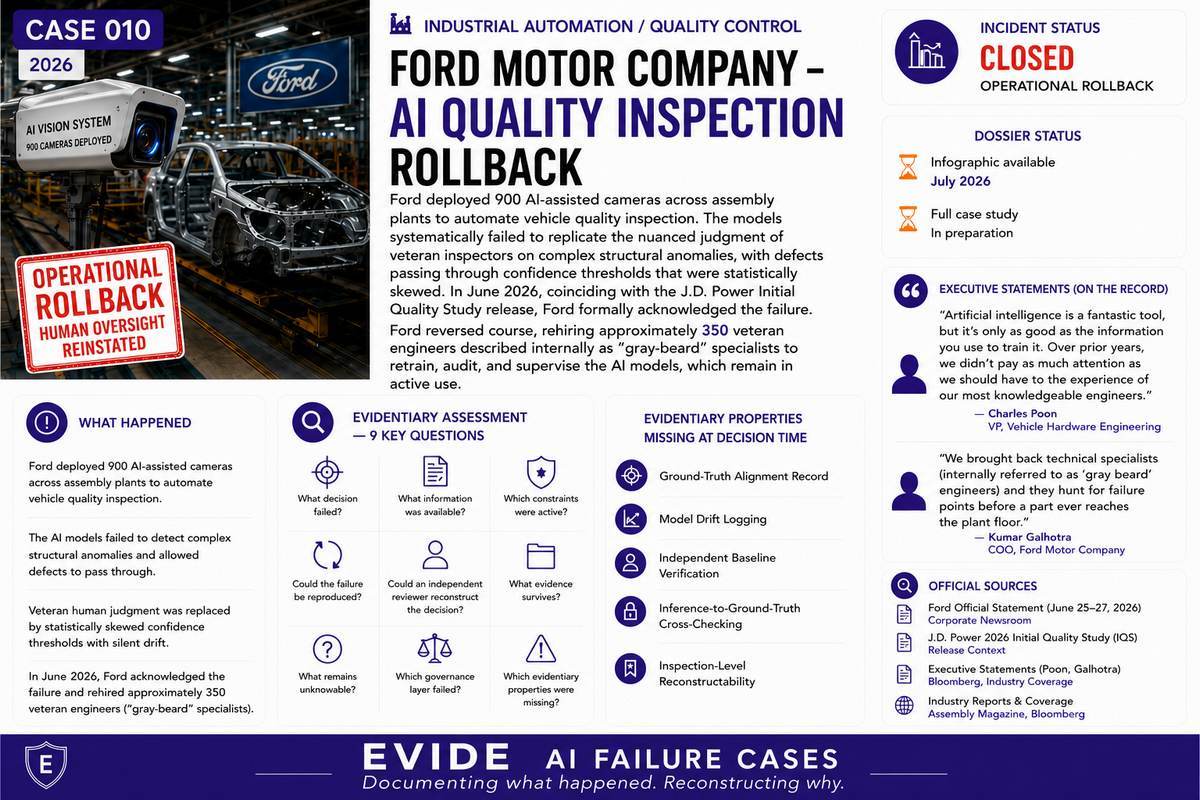
Ford Motor Company deployed 900 AI-assisted cameras across assembly plants to automate vehicle quality inspection. The computer vision models systematically failed to replicate the nuanced judgment of veteran inspectors on complex structural anomalies, with defects passing through confidence thresholds that were statistically skewed. In June 2026, coinciding with the J.D. Power Initial Quality Study release, Ford formally acknowledged the failure. VP of Vehicle Hardware Engineering Charles Poon stated: "Artificial intelligence is a fantastic tool, but it's only as good as the information you use to train it. Over prior years, we didn't pay as much attention as we should have to the experience of our most knowledgeable engineers." Ford reversed course, rehiring approximately 350 veteran engineers described internally as "gray-beard" specialists to retrain, audit, and supervise the AI models, which remain in active use across Ford's plants.
Evidentiary Assessment - 9 questions
What decision failed?
Automated quality assurance and defect classification - the computer vision models systematically misclassified complex non-standard structural anomalies as compliant, passing defective components downstream.
What information was available at the time?
High-resolution camera feeds and synthetic training profiles of ideal vehicle parts were available, but the models lacked the real-world contextual depth and edge-case experiential knowledge carried by long-tenured human inspectors.
Which constraints were active?
Statistical confidence thresholds were active, but the models experienced silent drift - accepting faulty components because the physical variations fell within mathematically skewed confidence intervals.
Could the failure be reproduced?
Difficult. Replicating the exact lighting conditions, camera lens degradation, assembly line speed, and subtle physical defect variations that bypassed the models requires physics-level environment reproduction.
Could an independent reviewer reconstruct the decision months later?
No. While systems logged binary pass/fail metrics, no structured evidentiary record was anchored explaining why a specific boundary deformation was cleared as a pass at the moment of inspection.
What evidence survives?
Ford official executive statements (June 25-27, 2026) including named on-record quotes from VP Charles Poon and COO Kumar Galhotra, corporate restructuring and HR rehiring documentation for the 350+ positions, and J.D. Power IQS context.
What remains unknowable?
The total number of vehicles currently on public roads carrying minor structural defects cleared by the flawed vision system during its active deployment, and the long-term warranty cost exposure.
Which governance layer failed?
The Ground-Truth Alignment and Sensor-to-Decision Validation layer. The system trusted model inference over human experiential baseline auditing without cross-checking automated classifications against an independent source of truth.
Which evidentiary properties were missing?
Inference-to-ground-truth cross-checking, historical model drift logging, independent baseline verification, and decision reconstructability at the individual inspection level.