
← All AI Failure Cases
 ← All AI Failure Cases
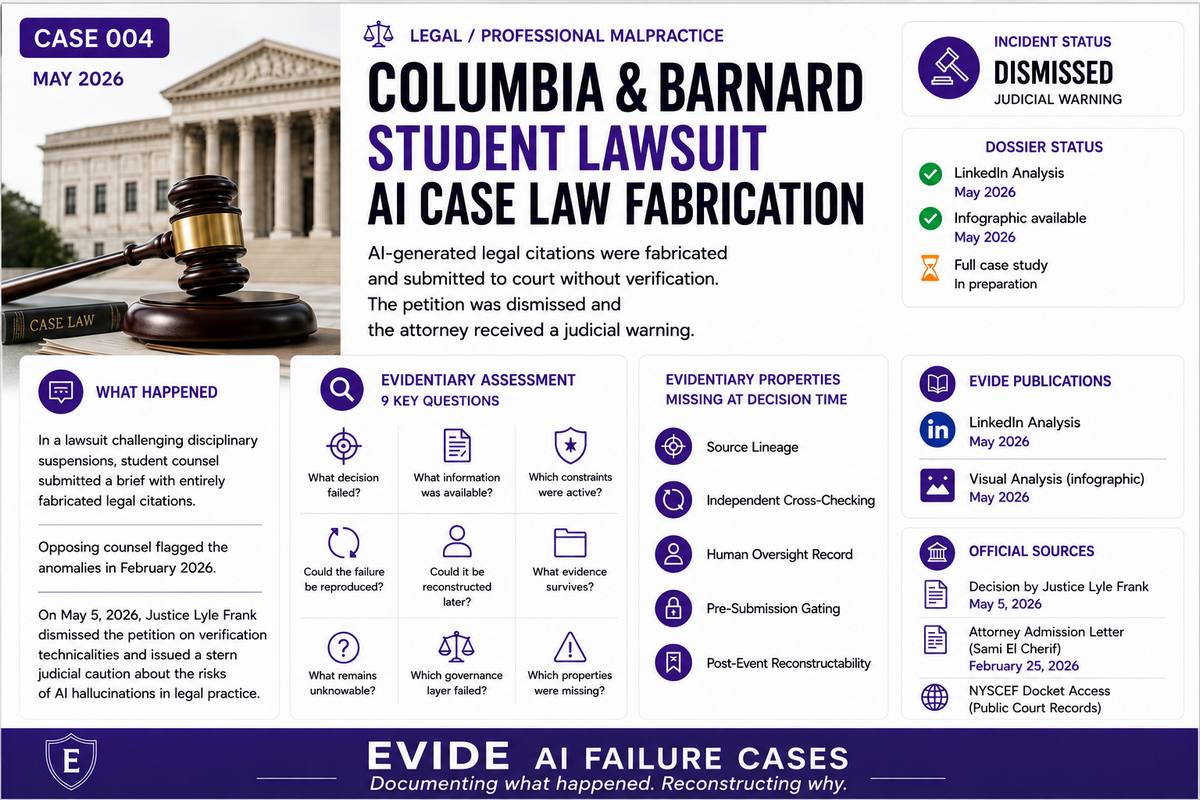
Columbia & Barnard Student Lawsuit - AI Case Law Fabrication
Incident status
Dismissed · Judicial Warning
Dossier status
✅ LinkedIn Analysis
✅ Infographic available
⏳ Full case study
What happened
During a lawsuit challenging the disciplinary suspensions of student protesters at Columbia and Barnard, petitioners' legal counsel submitted a briefing containing entirely fabricated legal citations. Opposing counsel flagged the anomalies in February 2026. On May 5, 2026, Justice Lyle Frank officially dismissed the case and issued a judicial warning, noting that the reach of AI in the legal field makes independent verification an absolute forensic duty for officers of the court.
Evidentiary Assessment - 9 questions
What decision failed?
The automated legal research and text-generation process — the system hallucinated non-existent judicial precedents, which were then integrated into a federal-level petition without human-in-the-loop verification.
What information was available at the time?
Official legal databases (Westlaw, LexisNexis, public court registries) contained the true, verified corpus of case law, but the generative model operated on unanchored probability weights without dynamic verification against a live legal registry.
Which constraints were active?
None that were verifiable. No retrieval-augmented generation (RAG) constraints or cryptographic alignment checks existed to tie the generated citations to actual historical court records.
Could the failure be reproduced?
No. The specific temperature, random seed, and exact context window configuration that led the model to invent non-existent case references cannot be mirrored without the proprietary runtime logs of the LLM provider.
Could an independent reviewer reconstruct the decision months later?
No. The attorney signed and filed the final PDF. No intermediate log or structured evidentiary record exists to prove how or why the AI chose those specific non-existent references.
What evidence survives?
The public court docket (NYSCEF), the formal apology letter from counsel Sami El Cherif filed February 25, 2026, and Justice Lyle Frank's dismissal ruling of May 5, 2026. The AI's prompt-to-output telemetry is entirely lost.
What remains unknowable?
Whether the attorney bypassed manual review due to deadline pressure, or whether the model's confidence scoring misled the operator into assuming the citations were verified.
Which governance layer failed?
The Professional Competence and Representation layer (Rule 1.1, Rules of Professional Conduct). Counsel failed to cross-check AI output against an independent source of truth before submitting to a public authority.
Which evidentiary properties were missing?
Source lineage transparency, independent cross-checking, human oversight logging, and pre-submission validation anchoring.
Evidentiary properties missing at decision time
EVIDE Publications
🖼
Visual Analysis (infographic)
July 2026 · Available
Related EVIDE Concepts